Strategic sustainability software: Must-have tools for growth

The standard has been to leverage a purpose-built software that does the organizational and export “heavy-lifting” for you; something particularly useful when working within expansive frameworks like the European Sustainability Reporting Standards (ESRS) or the EU Taxonomy. It’s something we offer specific support for at Position Green, but it does not do justice to what can be accomplished with a software built for strategy as much as compliance.
From compliance-focused sustainability to strategic advantage
In 2026, there’s never been a better time to pursue strategic sustainability, nor more companies who consider it a must-win battle. The high and imminent standards of comprehensive frameworks like ESRS still apply to the largest and most interconnected businesses within Europe, but they too recognize that the advantages they gain from their sustainability work far exceed the mandates of their reporting work.

“No company is punished for sustainability – and most will have something to gain. Exactly how much depends entirely on the sector and the individual company.”
Andreas Rasche, Professor of Business in Society, Copenhagen Business School.
For companies out of scope, this presents a unique opportunity. Without a directive to pursue compliance first and strategy second, they can focus wholesale on the business-positive opportunities lying dormant within their ESG data. But in order to do that, their sustainability software needs to mirror their ambition. It needs to be a strategic tool as much as a compliance tool.
What are the core areas of strategic sustainability?
Before we dive in, it’s important to understand the primary four areas of business operations that sustainability can impact for the better. Think of these as your four pathways to generating newfound revenue, mitigating potential costly outcomes (whether that is in malpractice, oversight, or disruption to your operations), reducing costs, or in accessing new markets, investments, or partnerships within your supply chain and beyond.
After all, it’s all part of strategic sustainability that only becomes valuable when it translates into outcomes the business already cares about. So, let’s isolate those four outcomes you may want to pursue:
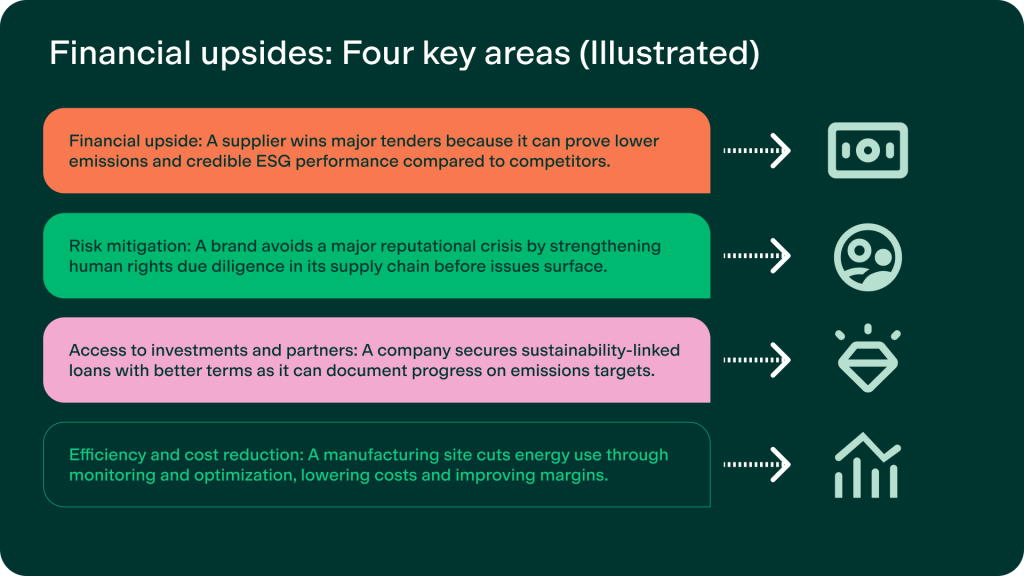
- Efficiency and cost reduction: The fastest wins are often operational: reduced energy and resource intensity, less waste, improved supplier performance, and more controlled internal processes, all of which improve margins.
- Financial upside: Sustainability can become a growth lever, enabling stronger positioning in tenders, premium offerings, customer preference, and new business models built around low-impact products and services.
- Risk mitigation: ESG performance is increasingly tied to exposure: regulatory risk, supplier instability, reputational damage, and operational disruption. Strong sustainability governance reduces the likelihood, and cost, of unpleasant surprises.
- Access to new investments and partners: From banks and investors to procurement teams and strategic supply chain partners, sustainability is becoming a filter for who gets funded, chosen, and trusted. Credible ESG performance opens doors that are otherwise closed.
These four pathways are where sustainability shifts from “something you report” to something you actively use to strengthen the business. So, with that in mind, let’s take a look at the core Position Green software features that support these four value creation areas.
Your core features for strategic sustainability work
Efficiency and interoperability between different sustainability software features is integral to maximizing the returns you make from your work. If you need to complete different activities in different tools, then you need to recompile your data each time to leverage it for every specific scenario.
Benchmarking as a tool for setting strategic targets
Benchmarking from a sustainability perspective is an effective way of assessing and determining your current progress level as compared to peers, by industry, size, or by region.
Regional benchmarking compares you to peers in your region. This is useful for setting realistic targets based on local conditions and regulation.
Industry benchmarking compares you to peers in your sector. This is useful for understanding competitor performance and what customers/investors will increasingly expect.
More importantly, it supports concrete value creation by helping you:
- Identify competitive gaps early (and avoid losing ground in tenders, partnerships, or investment decisions)
- Prioritize high-impact initiatives by focusing effort where peers are outperforming — rather than spreading resources thin
- Set targets that are both ambitious and defensible, grounded in what leaders in your sector are already achieving
- Strengthen your market positioning, using benchmark data to prove leadership rather than simply claiming it
- Unlock efficiency improvements by revealing where your cost base is inflated compared to competitors (energy intensity, waste, logistics, procurement)
In short: industry benchmarking turns sustainability from an internal reporting exercise into an external competitive tool, one that helps you protect market share, improve margins, and build credibility where it counts.
With Position Green’s ESG benchmarking tool, you can do both, using the same data you’ve already reported. Instead of benchmarking becoming a separate analysis project, it becomes a built-in capability: always available, always current, and directly connected to your reporting dataset.
The results are based on a proprietary private dataset, meaning you’re not relying on incomplete public disclosures or outdated market assumptions. You can trust the comparisons and use them confidently in decision-making, prioritization, and target-setting.
The feature also provides automated, tailored insights based on your own reported data highlighting where you’re ahead, where you’re falling behind, and what actions are most likely to close the gap. This turns benchmarking into more than a scoreboard: it becomes a practical tool for value creation.
Decarbonization for financial upside
As a direct compliment to your benchmarking work, Position Green offers a feature that allows you to take these insights and use them to plot out a smarter path to decarbonization. From an environmental standpoint, the gains you make from decarbonizing are obvious, but let’s unpack briefly why it can also be a huge strategic asset.
At its best, Decarbonization Modelling turns emissions reduction from a vague ambition into a financially informed strategy. It allows you to pressure-test different pathways, compare trade-offs, and make smarter prioritization decisions, before you commit CAPEX, restructure operations, or set targets you can’t realistically hit.
In practice, this unlocks three key value creation levers:
- Efficiency and margin improvement by identifying where emissions reductions overlap with reduced energy and resource intensity
- Risk mitigation by reducing exposure to volatile energy markets, supply chain disruption, and tightening regulation
- Commercial advantage by strengthening your position in procurement processes, investor conversations, and partner ecosystems where decarbonization performance is increasingly non-negotiable
In other words, decarbonization modelling doesn’t just help you cut emissions, it helps you choose the most strategic way to do it, and make the business case clear to leadership at the same time. We put together a case example to highlight the upsides of this; breaking down how a single energy datapoint can be leveraged to generate 5-figures worth of savings each year for a business.
Instead of relying on generic reduction plans or one-off spreadsheets, you can model different pathways and forecast outcomes before you invest time, budget, or operational capacity.
You can also forecast the impact of your decisions, prioritizing initiatives that deliver the highest emissions reduction for the least effort. This makes decarbonization more practical, faster to execute, and easier to justify internally.
To accelerate this further, our platform provides AI-powered suggestions that are tailored to your organization’s footprint and context, meaning recommendations are aligned with your actual emissions profile, operational structure, and reporting data, rather than broad best practices.
Because decarbonization is one of the areas where sustainability most directly connects to business performance, modelling often becomes one of the strongest ROI opportunities in sustainability work. Reducing emissions frequently overlaps with reducing energy use, material waste, and inefficiencies, which means progress can translate into measurable cost savings, not just better reporting.
Speaking of AI-powered, let’s dive into that as the next value creation asset built-in to our platform.
AI in Position Green: cost savings through efficiency, plus better decisions
AI in Position Green is designed to create measurable value, not “innovation theater.” It does this in three concrete ways, starting with the most immediate ROI driver: reducing manual work.
1) Lower costs by reducing manual reporting work (AutoReporting)
For most companies, the real cost of sustainability reporting isn’t the framework—it’s the labor. Hours spent chasing data, formatting disclosures, rewriting narratives, and validating outputs across teams adds up quickly.
Position Green’s AI-supported AutoReporting reduces this burden by accelerating the creation of disclosure-ready outputs using the data already captured in the platform. That time saving becomes a direct cost saver because it:
- Reduces internal hours spent on repetitive admin work
- Limits dependency on external consultants for basic drafting and formatting
- Shortens reporting cycles (less overtime, fewer last-minute scrambles)
- Frees sustainability teams to focus on value-driving initiatives instead of document production
In short: fewer manual hours = lower cost per reporting cycle, and less organizational drag.
2) Actionable insights that drive value (Benchmarking + Decarbonization)
AI also supports value creation by helping teams prioritize what matters most. As we’ve alluded to in Benchmarking and Decarbonization Modeling, AI helps translate reported ESG data into insights you can act on, highlighting gaps versus peers, identifying the biggest reduction levers, and surfacing next best actions based on your company’s footprint and context.
That’s where AI shifts from productivity to performance: it helps you make better decisions faster.
3) Trust and transparency, backed by experts
AI only creates value if the outputs are credible. That’s why Position Green emphasizes trust, traceability, and transparency, supported by sustainability experts. The goal is to ensure AI outputs can be used confidently in leadership discussions, planning cycles, and governance processes, without creating risk or “black box” uncertainty.
This is crucial for acting on the AI’s suggestions but also when you need to hold your strategic plan’s feet to the fire. When getting buy-in or simply assessing your current AI suggestions, you can always find out why the AI is suggesting what it is suggesting by going straight to the source in your own data.
For years, sustainability software has been judged by one primary metric: how efficiently it can get you through the reporting season. And while that still matters, it’s no longer the real benchmark for success.
In 2026, the companies pulling ahead are the ones using sustainability data as more than documentation. They’re using it as a strategic asset: to benchmark themselves against peers, identify gaps worth closing, model decarbonization pathways with real ROI potential, and automate the heavy lifting so internal teams can focus on decisions, not admin.
That’s the shift at the heart of strategic sustainability; moving from compliance outputs to business outcomes. Whether your goal is cost reduction, risk mitigation, investment readiness, or market advantage, the common denominator is the same: having the right data, in the right structure, with the right tools to act on it.
Build strategy from the data you already have
If you’re already collecting ESG data, or preparing to, you’re sitting on far more value than a disclosure document can capture.
Position Green is built to help you turn sustainability work into measurable business performance, by connecting compliance-ready reporting with strategic features like Benchmarking, Decarbonization Modeling, and AI-supported automation and insights, all grounded in traceable, trustworthy data.
If you want to see what strategic sustainability looks like in practice, book a demo with our team and we’ll show you how to move from reporting to real value creation, using the data you already have.
Chat with us
Daniel Schermerhorn
Product Marketing Manager
Position Green