How VBG Group is building sustainability across a decentralized organization
For VBG Group, this challenge is particularly clear. With a small central team and highly decentralized operations, sustainability cannot be driven from the top down in a traditional sense. It has to be built into how the organization operates globally.
From central ambition to local execution
VBG Group operates with a small headquarters team and a structure where divisions run their own businesses.
Targets are set centrally, but execution sits with each division. This applies equally to sustainability.
Rather than centralizing responsibility, VBG Group has created a model where sustainability is coordinated centrally but owned locally. A Sustainability Council brings together representatives from across the divisions, while each business unit is responsible for translating targets into action.
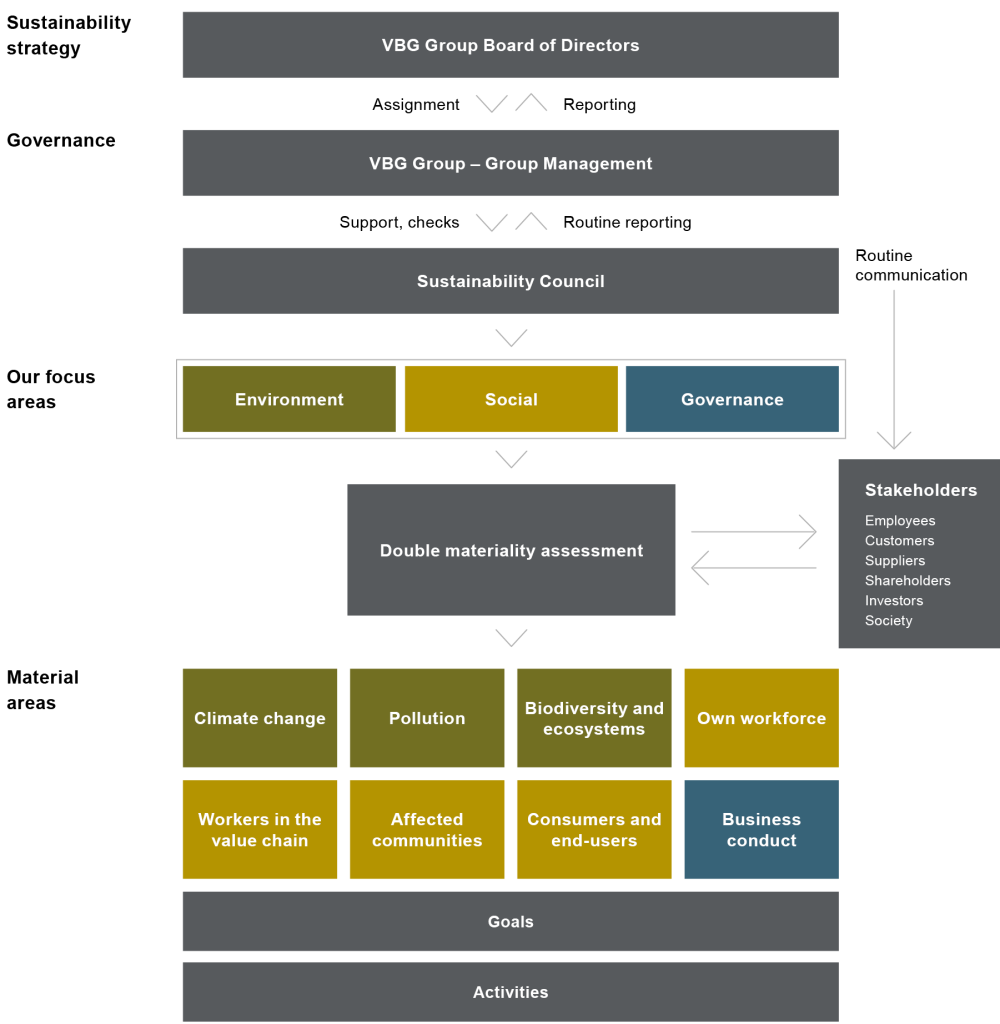
This mirrors how financial performance is managed. The goal is not to control operations from the center, but to ensure alignment:

“The global targets are set centrally and then needed action plans and activities are done within each division. Divisions still run their own business.”
Per Sandberg, Group Sustainability Analyst, VBG Group
Consistency is achieved not through central control, but through shared structure, tools, and governance.
The reality of ESG: supply chain complexity
When it comes to ESG priorities, one area stands out clearly. The supply chain. For VBG Group, approximately 93% of emissions sat upstream in 2024 and 90% in 2025, within Scope 3 and direct materials.
This shifts the focus away from internal optimization and toward supplier engagement.
The challenge is not only environmental. It also includes social and governance aspects, such as ensuring suppliers meet standards around labor practices and compliance.
In practice, this creates a different type of sustainability work that prioritizes:
- Working collaboratively to improve performance
- Building long-term supplier relationships
- Moving beyond price-driven procurement
- Increasing transparency across tiers
Making sustainability work beyond Europe
One of the more practical challenges in VBG Group’s approach is geographical.
While sustainability reporting and regulation are well established in Europe, this is not the case across all regions where the company operates, which include sites as far flung as North Vernon, Indiana or South America.
Some sites are familiar with regulatory expectations and sustainability concepts. Others operate in environments where these requirements are less visible or less developed.
As a result, implementation is not just about rolling out processes, rather it is about building understanding.
Instead of relying on local regulatory pressure, VBG Group has taken a global approach. Sustainability is introduced as part of how the business operates, regardless of geography.
In practice, this meant sitting down with local teams and working through their specific context. For example, a site might need to define:
- Where energy data is sourced from
- Who is responsible for reporting it each month
- How deviations are explained and documented
Rather than applying a generic template, each site builds a process that fits how it already operates.
This is where structure becomes critical and a common set process needs to be implemented, which is done within the Position Green platform.
A common platform ensures that expectations, definitions, and reporting processes are consistent across all regions. It creates a shared baseline, even where local regulations differ.
Over time, this enables sustainability to be embedded across the organization, not because it is mandated locally, but because it is required globally.
Making sustainability operational across 150+ reporters
Turning sustainability into something that works across a decentralized organization requires an operational rollout.
At VBG Group, this meant engaging more than 150 individuals across sites globally, each responsible for contributing data and following reporting processes.
Rather than relying on central communication alone, the team spent significant time onsite, running multi-day sessions across key locations in Europe and North America. These sessions covered:
- What sustainability means for the business
- Why it matters beyond compliance
- What each site is expected to report
- How to use the reporting platform
This was followed by ongoing training and support. The process was not immediate. It required repetition, follow-up, and iteration. Or as Per frames it:
“First you show them how we conduct sustainability here in Europe, then they need to get in themselves, and then you need to start doing.”
The platform plays a key role here as it does not replace the need for training or ownership, but it provides a consistent framework that guides contributors through what needs to be reported and how. This reduces ambiguity and makes it easier to scale reporting across a large number of sites.
Building consistency without centralizing control
In a decentralized model, consistency becomes a key concern.
VBG addresses this through a combination of:
- Shared reporting platforms
- Common structures and definitions
- Local responsibility for processes
Each site is required to establish its own internal processes for reporting. This includes defining:
- Who is responsible
- How data is collected
- How it is validated
- How it is reviewed
The Position Green platform supports this by embedding structure directly into the reporting process.
It enables:
- Standardized data collection across all sites
- Built-in validation and review workflows
- Clear traceability of reported data
- Aggregation of local inputs into group-level reporting
This allows VBG Group to maintain consistency without removing local ownership, a key requirement in a decentralized organization.
From data collection to decision-making
Once data is in place, its value depends on how it is used.
At VBG Group, reporting data serves as the foundation for setting targets and tracking progress.
For example:
- 2024 data is used to establish baselines
- In 2022, Scope 1 & 2 targets were set for 2030. Waste reduction targets were also set for 2030 in 2022.
- Divisions use reporting outputs to monitor performance
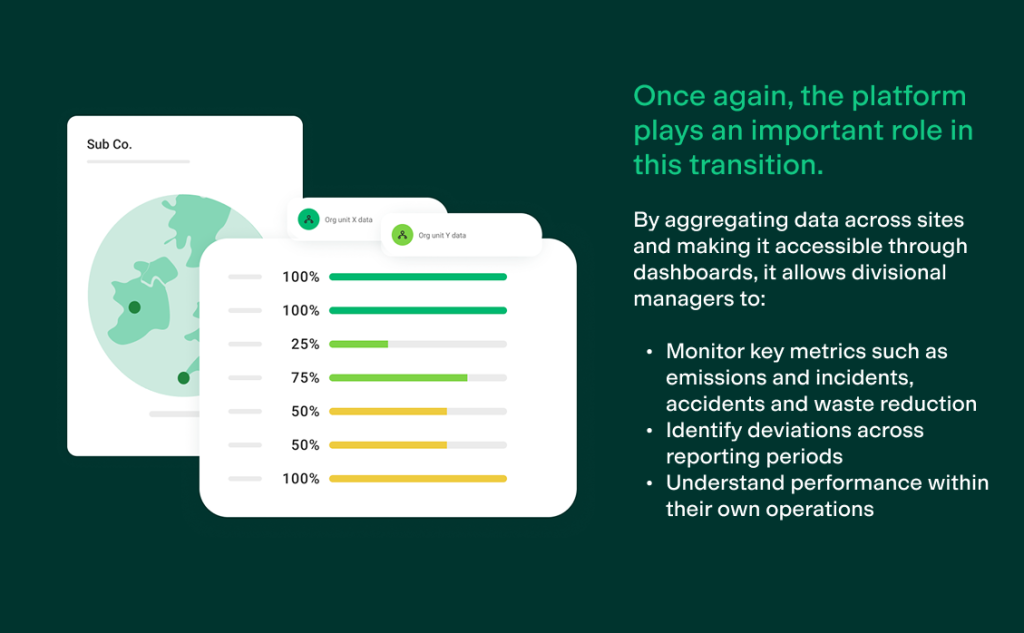
This shifts sustainability reporting from a static exercise to something that actively supports decision-making.
Scaling sustainability across acquisitions
Growth introduces another layer of complexity. When new companies are acquired, they need to be integrated into both financial and sustainability reporting processes.
At VBG Group, this follows a structured approach:
- Financial reporting is established first
- Sustainability reporting follows, leveraging Position Green as their collaborative hub
- Training and onboarding mirror the process used across existing sites
The adaptability of Position Green becomes a crucial function here; with teams able to leverage their best-practice internal processes and enable them cross-continentally with Position Green.
It allows new entities to be onboarded into an existing structure, rather than building processes from scratch. Initial reporting may start with simplified methods, but the system supports a transition toward more accurate and detailed data over time.
This makes it easier to scale sustainability alongside business growth.
Sustainability beyond compliance
While regulation is a key driver, it is not the only one. For VBG Group, sustainability is increasingly shaped by external expectations.
These include:
- Customer demands for ESG data
- Investor and lender requirements
- Community and societal expectations
- Internal expectations from employees
- Suppliers as key stakeholders
These pressures are not isolated. They are converging and directly impacting their access to capital, a core necessity for a business built upon acquiring new divisions across so many different sites.
“Banks are not going to lend money to companies that don’t have a sustainable profile. By factoring in sustainability, we’re playing a long-term survival game.”
Per Sandberg, Group Sustainability Analyst, VBG Group
This reinforces the need for reliable, structured data, not only for compliance, but for credibility with stakeholders.
A practical model for global sustainability work
VBG Group’s approach highlights a model that many industrial companies are moving toward.
It is defined by a few key principles:
- Central direction with local ownership
- Structured processes rather than ad hoc reporting
- Strong focus on supply chain engagement
- Continuous training and capability building
- Systems that support, rather than dictate, operations
The role of the platform is not to drive strategy, but to enable this model to function at scale. It provides the structure needed to connect decentralized operations with centralized reporting and oversight.
What other companies can learn
For companies building sustainability processes across global operations, the key takeaway is not to start from scratch.
This means:
- Learning from others, but adapting to your own structure
- Understanding stakeholder expectations clearly
- Building processes that fit how your business already operates
- Taking a long-term view rather than focusing only on immediate compliance
Crucially, as well, it also means having the flexibility in the tools you use to adapt as your company expands. Rather than traditional ERP systems which may force you to orient your processes towards their built-in systems, platforms like Position Green allow you to compose a set-up aligned to your ways of working.
The effect of this is that sustainability stops becoming a process in isolation, but a foundational link in the chain of operations that keep your business competitive. If you want to make that a must-win-battle for your organization and leverage a platform built to support your strategic, as much as sustainable, ambition, we’re here to chat!
Explore Position GreenStay up to date with the latest ESG-trends with our newsletter
About VBG Group
Through its specialized divisions, the company offers products and services that enhance safety, efficiency, and sustainability in transport and infrastructure. With a strong heritage in engineering and a global presence, VBG Group combines technical expertise with long-term partnerships to create value for customers and society.
You can now read their Annual Report for 2025 that also includes their sustainability report for the year.