


The financial cost of waiting a year on ESG management software

Since the EU’s 2026 Omnibus reforms narrowed the scope of the CSRD and CSDDD (more on what those are below), that deadline now reads as 2027, 2029, or later for a lot of companies, so the request gets filed under not urgent, revisit next year. That is the comparison most boards actually run, and it is the wrong one.
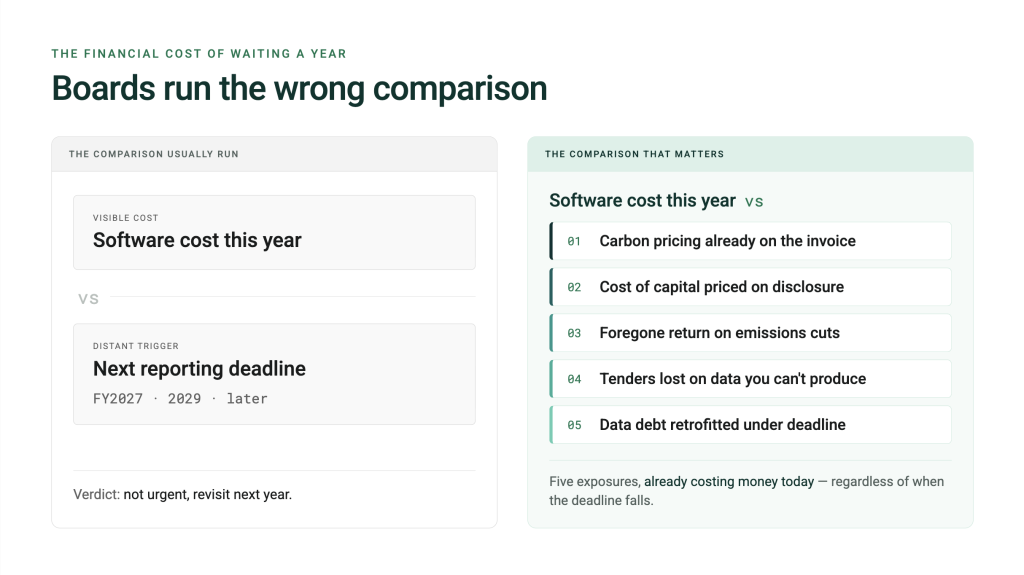
It weighs a visible cost today against a compliance date that has moved further away, and it leaves out everything that is already costing money in the meantime. Below is the fuller comparison, mapped to five specific exposures and the parts of a platform that address each one directly.
Exposure 1: Carbon pricing that is already live, not pending
Bottom line: if your company imports steel, aluminium, cement, or fertiliser into the EU, this cost is already on this quarter’s invoice, not on some future compliance date.
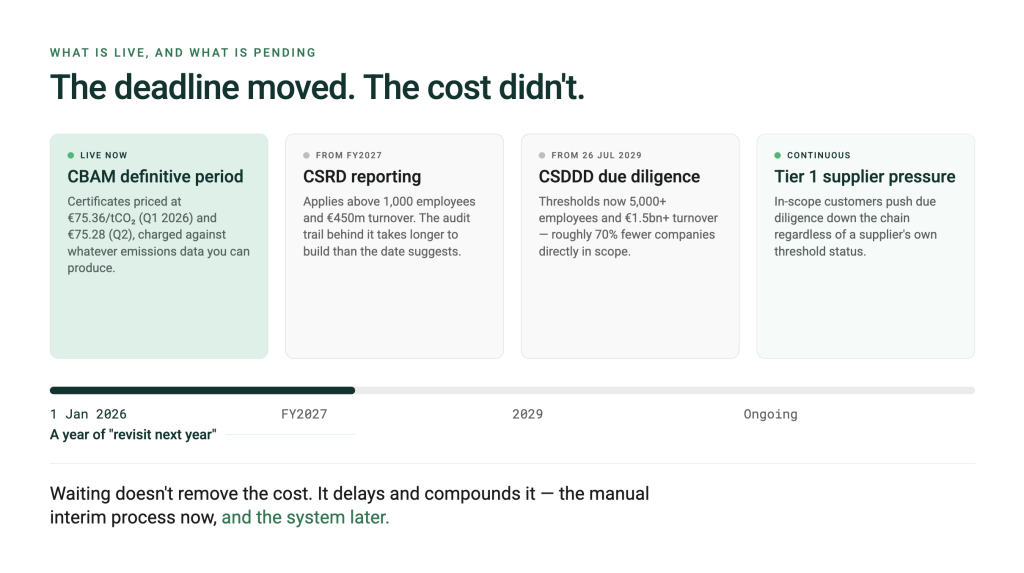
The CBAM definitive period, the definitive phase of the EU’s Carbon Border Adjustment Mechanism, started 1 January 2026, and the transitional, reporting only phase is over. CBAM charges those imports the same carbon cost that a company inside the EU already pays on its own emissions through the EU’s existing carbon market, the EU ETS. Certificate prices track that EU ETS price and were set at 75.36 euros per ton of CO2 for the first quarter of 2026 and 75.28 euros for the second.
For any company importing covered goods, this is a cost on this quarter’s invoices, calculated against whatever emissions data the company can produce.
Bottom line: the less accurate a company’s emissions data, the more it typically ends up paying. Underneath the carbon problem sits a data quality problem. Companies without activity based Scope 1 to 3 accounting, meaning direct emissions (Scope 1), emissions from purchased energy (Scope 2), and emissions across the supply chain (Scope 3), tend to default to conservative estimates or supplier averages, and both routes tend to overstate liability compared with accurate, primary data.
Position Green’s carbon management module auto calculates emissions from spend and activity data, with Scope 3 visibility built in, so the number a company reports is closer to the number it owes. The gap between an estimate and an accurate figure shows up as real euros per ton.
Exposure 2: cost of capital tied to disclosure quality
Bottom line: lenders and investors are already charging companies differently based on whether they disclose ESG data, whether a company is in the room for that conversation or not. CDP, the global environmental disclosure platform that most large companies already report to annually, publishes an annual Disclosure Dividend report tracking what disclosure is worth in financial terms.
The 2026 edition, built on disclosure data from over 11,260 companies representing roughly two thirds of global market capitalization, found that companies disclosing through CDP are priced as carrying approximately 35 percent lower transition risk, the risk that markets price into a company’s value as economies shift away from carbon heavy activity, than otherwise similar peers by 2050. That gap is worth more than 1 trillion dollars in aggregate enterprise value across the disclosing cohort, and it holds after controlling for company size, sector, and region.
Standardized, audit ready ESG data is what investors and lenders use to price that risk into cost of capital, sustainability linked loan terms, and green bond eligibility. Without it, a company isn’t simply left out of that calculation. It gets priced at the peer average, or at whatever conservative estimate a lender assigns in the absence of disclosed data.
Position Green’s ESRS reporting solution builds a complete, audit ready sustainability statement on top of a double materiality assessment, the analysis that pins down which sustainability issues could actually hit the company’s financials, and which of the company’s own impacts carry enough weight to draw regulatory or investor scrutiny, rather than a spreadsheet reconstructed under deadline. That is what makes the resulting data usable by capital markets in the first place.
Exposure 3: foregone return on emissions reduction
Bottom line: profitable emissions cutting projects exist right now, and every year spent without visibility into them is a year of that return going uncaptured. The same CDP report quantifies the return side of the equation:
- A dollar invested in emissions reduction initiatives returns an average of 2.4 dollars, and up to 7 dollars over an initiative’s lifetime.
- 69 percent of reported initiatives are profitable.
- 41 percent pay back within three years.
None of that accrues automatically. Capturing it requires knowing where the reduction opportunities sit, which in turn requires an accurate baseline and forward looking modeling rather than an estimate rebuilt each year after the fact.
Pairing auto calculated emissions with scenario modeling and AI powered forecasting, as Position Green’s carbon management platform does, converts raw emissions data into a ranked list of reduction levers by expected return. A year spent without that visibility is a year of initiatives left unidentified and unfunded, while the return above keeps accruing to whoever is already running them.
Exposure 4: procurement exclusion and Tier 1 pressure
Bottom line: a company too small to be legally covered by CSDDD can still lose a contract because a larger customer needs the data anyway. Post Omnibus, CSDDD, the EU’s Corporate Sustainability Due Diligence Directive, which requires large companies to check their own suppliers for human rights and environmental risk, now applies at thresholds of 5,000 or more employees and 1.5 billion euros or more in turnover, a roughly 70 percent reduction in the number of directly in scope companies.
Due diligence obligations for the companies still in scope, however, extend down the supply chain regardless of a supplier’s own threshold status. A mid sized supplier well below the CSDDD line, in other words, one of a large customer’s direct, Tier 1 suppliers, can still lose a tender because that customer’s own due diligence process requires supplier level emissions and labor data the supplier cannot produce on request.
That is a revenue exposure rather than a regulatory one, and it shows up as a lost contract rather than a fine. Answering a customer’s due diligence request in days instead of months depends on having the infrastructure already in place: automated risk scoring, tailored questionnaires, and group visibility across tiers, which is the core of Position Green’s supplier management module.
A manual, spreadsheet based response assembled under deadline is frequently what costs the tender before the pricing conversation even starts.
Exposure 5: data debt that compounds into a compressed compliance cost
Bottom line: waiting doesn’t remove this cost, it just delays and compounds it, a company still ends up paying for the manual process now and the system later. CSRD reporting, the EU’s Corporate
Sustainability Reporting Directive, now applies from FY2027 for companies above 1,000 employees and 450 million euros in turnover. CSDDD applies from 26 July 2029. Both dates look distant enough to defer preparation, but the underlying data infrastructure, consistent activity data, clear ownership across finance, procurement, and operations, and an audit trail that holds up to assurance, takes longer to build than the deadline suggests. It does not build itself in the final quarter before the reporting year.
Each month spent without that infrastructure leaves behind manual, inconsistent data that eventually has to be retrofitted rather than simply reused. A single sustainability data hub, where information is entered once and reused across carbon accounting, ESRS reporting, and supplier management, as in the Position Green platform, is what prevents that retrofit cost from accumulating. Companies that wait typically end up paying for the manual interim process and the eventual system implementation, rather than the system cost alone.
The AI dimension of the cost
Across all five exposures above, the recurring cost is coordination and manual labor, chasing data from procurement, finance, and suppliers, reconciling inconsistent formats, and rebuilding calculations each reporting cycle. AI powered features change that cost structure rather than just the workflow:
- AI pre fill for ESRS reporting, drawing data directly from uploaded documents.
- Automated risk scoring across supplier tiers, replacing manual review.
- AI driven decarbonization forecasting within carbon management, ranking reduction levers by return.
Each of these converts a cost that scales with headcount into one that is largely fixed. A year spent on manual process is a year spent paying the labor scaling version of that cost instead of the flat one, and the gap between the two widens as reporting scope expands under any of the frameworks above.
Putting a number on a year of delay
None of this reduces cleanly to a single figure, because the exposures sit in different places on the balance sheet: cost of capital, carbon pricing, tender revenue, and reporting labor cost. But each one is a live, measurable number today, not a projection contingent on a future regulatory trigger.
CBAM’s per tonne cost is on this quarter’s invoice. The 35 percent transition risk gap is already priced into how disclosers and non disclosers are valued. The 2.4 to 7 dollars return on emissions initiatives is already being captured by companies running them now. A year of wait and see does not pause any of these figures. It is a year spent absorbing all five at the less favorable end.
Put simply, the comparison a board usually runs, software cost this year against a compliance deadline further out, is missing most of the number. The real comparison is software cost this year against what these five exposures are already costing regardless of when the next deadline falls.
The other side of the ledger
Read the other way, the same five exposures describe what is available to a company that moves now rather than in a year. A defensible carbon figure instead of a conservative default. A cost of capital priced on disclosed data instead of peer averages. A share of the 2.4 to 7 dollars return on emissions initiatives instead of none of it.
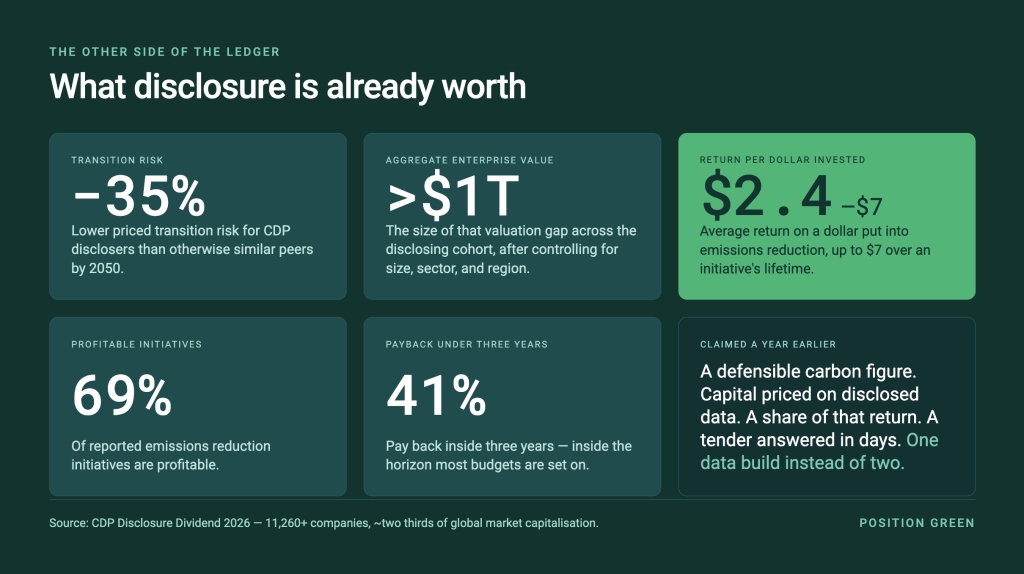
A tender answered in days instead of lost before the pricing conversation starts. A single data build instead of two. None of that is speculative. It is the same data already cited above, just claimed a year earlier.
That is the case for building the infrastructure now rather than after the next deadline forces it. Position Green brings carbon management, ESRS reporting, and supplier management together on one data hub, with AI doing the collection and consolidation work, so the return above is something a team can actually go after rather than just calculate.
Making the case for the business
This article was written to give your business clear, defensible reasons to not put a pause on your sustainable software implementation or strategic foresight. To make it all the more communicable, we’ve gone one step further and created a dedicated one-pager outlining the most important information shared in this article.
Share it with your colleagues who need either financial or strategic justifications broken down for them in a brief, palatable format
Access one-pager