

Resilience as advantage: How climate science informs your sustainability strategy
Johan Rockström opened his talk at Position Act with a simple visual comparison: two photographs of Earth, taken 60 years apart. The Apollo 8 crew in 1968 saw a fragile blue marble. The Artemis II crew in 2024 saw the same planet, but the scientific reality between those images had fundamentally shifted. We are no longer a small world on a big planet with room to spare. We are now, scientifically and operationally, a big world on a small planet with a hard ceiling. For the sustainability professionals in the room, this distinction was not rhetorical. It was the foundation for everything that followed.
His message cut past the noise of compliance frameworks and reporting standards to address something more urgent: resilience. Not as a buzzword, but as the central business question of the next decade. The curve has bent the wrong way.
We have five years of remaining carbon budget at current emission rates. Tipping points in Earth systems, the Atlantic Meridional Overturning Circulation, the Amazon rainforest, permafrost, are no longer theoretical risks. They are now showing measurable signs of instability. And for any company relying on stable supply chains, predictable weather patterns, or access to capital, that instability is not a future problem. It is a present constraint on operations and strategy.
The planet is now the limiting factor, not the buffer
For decades, the business model worked like this: extract, add value, sell, dispose. The planet absorbed the externalities. Today, that model has hit a hard biophysical ceiling. Rockström explained this through the lens of the “Great Acceleration”, a term that describes the exponential rise in both economic activity and environmental impact since 1955.
The curves are synchronized. Every measure that matters, carbon emissions, biodiversity loss, acidification, land conversion, follows the same pattern: linear for a century, then exponential. And we have not bent them. Two months ago, new research showed emissions rising by 1 to 2 percent per year, even as climate science demands we cut them in half by 2030.
“We’re no longer at a point where we can negotiate with the planet. There’s no more room for any business to run on linear trajectories,” Rockström said. For sustainability professionals, this is the operational reality you are managing against. Companies cannot grow incrementally and expect the planet to absorb the impact. The constraint is now active. This shifts the entire conversation from “How do we become more sustainable?” to “How do we operate within a bounded system?” The second question forces innovation, efficiency, and genuine trade-off decisions. It forces strategy.
We will overshoot 1.5°C. The question is what we do about it.
The Paris Agreement target of 1.5 degrees Celsius is scientifically understood by most professionals. What Rockström presented was harder to accept: there is no pathway to stay below 1.5°C without first exceeding it. Every viable IPCC (Intergovernmental Panel on Climate Change) scenario now shows overshoot. Within 5 to 10 years, the planet will cross the threshold. What matters now is how far we overshoot, how fast we pull back, and how quickly we stabilize a “safe and just corridor for people and the planet.”
This is not defeatism. It is a recalibration of what success looks like. Success is no longer avoiding 1.5°C. Success is minimizing overshoot, limiting the duration, and ensuring that the transition that follows does not collapse ecosystems or equity. For companies and sustainability leaders, this changes where you place your bets.
It is not enough to set net-zero targets for 2050. The decisive decade is now. The reduction pathway is steep. Every ton of emissions avoided between now and 2030 determines not just the peak temperature, but the resilience of your supply chains during the transition that follows.
This is why Rockström frames all forms of climate action, whether in energy, food systems, or circular economy, as “a pathway to handle a constraint with drive innovation, efficiencies, and responsible handing over of stability for current and future generations.”
The upside to this is that mitigating your own risks has a knock-on effect globally. We all know, for example, that most business emissions sit within Scope 3, i.e., those outside of your direct operations. By reducing these, you de facto reduce your supplier’s own emissions and help them forge a more resilient practice, as well. Competitors that don’t take action will likely face higher costs later as they work to mitigate risks, both to their own business and to their stakeholders.
Tipping points are hard-wired and no longer distant
The most unsettling part of Rockström’s presentation focused on what he calls “hard-wired tipping points”, thresholds in Earth systems beyond which change becomes abrupt and potentially irreversible. The Amazon rainforest. The Atlantic overturning circulation. Arctic ice. Permafrost. These are the infrastructure of global weather patterns, ocean currents, and water cycles that directly affect where it rains, where it floods, where crops grow, and where capital flows.
The AMOC (Atlantic Meridional Overturning Circulation) provides a concrete example. A collapse would trigger a “cold blob” phenomenon in the North Atlantic, shift rainfall patterns across Africa and Asia, weaken monsoons, dry out Europe, and destabilize fisheries and carbon cycles across the Atlantic basin. New evidence suggests this is no longer a “low likelihood event” as measurable slowdown has been observed since 1940.
For companies with supply chains in Europe, West Africa, or the Atlantic region, or capital dependent on agricultural output in these zones, the risk profile has shifted from “potential” to “emerging”, meaning it is a potential exposure that all businesses must contend with.
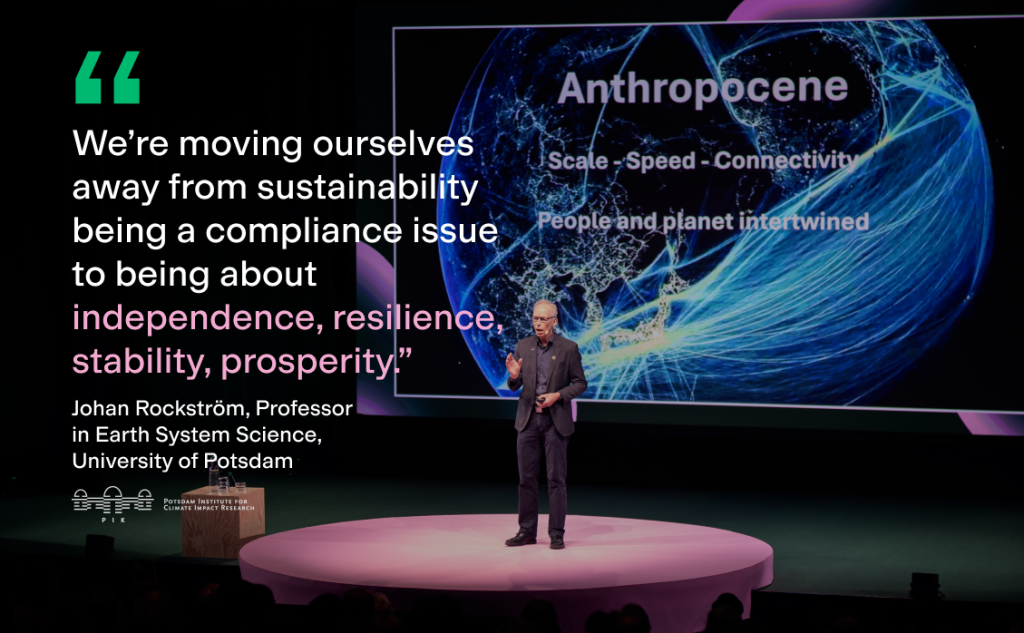
And it summarizes a key issue with viewing risk mitigation too locally for your business. Supply chains are, after all, global and while the planet is warming, how this manifests across the different planetary systems varies, meaning you need to think about adaptation across a number of different dimensions, be it desertification or cold spikes in the Scandinavian regions.
Five years of carbon budget remains. The speed of transition now determines outcomes
At current emission rates, humanity has roughly 130 gigatons of CO2 remaining before exhausting the carbon budget aligned with 1.5°C with a 50 percent likelihood of success. That is approximately five years. This is not a speculative number. It is the output of peer-reviewed carbon accounting research. It is the constraint within which all climate strategy must now operate.
What makes this constraint useful rather than paralyzing is that it forces clarity. Every tonne of emissions reduction matters. Every sector transformation, energy, food, transport, industry, must accelerate. Rockström pointed to an emerging counterforce: the speed of renewable energy expansion.
As fossil fuel prices spike and geopolitical risks rise, the cost-competitiveness of solar and wind continues to improve. The window to transition away from fossil fuels in “a science-aligned, orderly way that secures stability, resilience and equity” is still open. But it is closing. The transition must happen at exponential speed and scale, not incremental pace.
For those businesses that are able to orchestrate rapid transformation while maintaining operational continuity and competitive position, this is a clear advantage even on a five year timescale, but something that can be directly impacted by leveraging smart systems such as decarbonization modeling systems or benchmarking capabilities. With the right systems in place, businesses can move faster, make more informed decisions, and maintain competitiveness throughout the transition.
What sustainability leaders can do now
Rockström closed by referencing the “Santa Marta Momentum”, a commitment to transition away from fossil fuels in a manner that is scientifically aligned, operationally orderly, and equitable. This is not a pledge. It is a framework. For sustainability professionals in the room, the implication was that their work is no longer about reporting compliance or ticking boxes. It is about enabling your organization to operate as a fast-moving, resilient actor within a constrained planetary system.
This means translating Rockström’s science into three operational priorities:
- First, map your actual exposure to tipping-point risks—not theoretical climate impacts in 2050, but measurable changes in AMOC, Amazon stability, and permafrost degradation happening now, and what they mean for your specific supply chains and markets.
- Second, accelerate emissions reduction to align with the five-year carbon budget constraint, not a 2050 net-zero target. Set 2030 milestones as hard boundaries, not aspirations.
- Third, use the “constraint as innovation driver” framework. Scarcity of carbon space forces efficiency, circular design, and supply chain resilience. Companies that treat the carbon budget as a resource to allocate—not a problem to minimize—will outcompete those still operating on the old model.
The window to shape the transition is still open. But it is narrowing by the year. Your work as a sustainability professional is to ensure your organization is moving fast enough, and in the right direction, to be on the right side of that transition when it accelerates.
Take your next steps towards climate-ready resilience
If you want to set your resilient ambition in motion and need both the tools and the expertise to ensure you are doing so efficiently and with genuine impact, our platform is here to help. Equipped with both specific solutions to core compliance needs and an ever-expanding rage of impact tools, from benchmarking to AI analysis, it puts you in the driver’s seat of your company’s best possible climate transition.
Chat today