How to evaluate your ESG reporting process throughout the year
This article outlines how companies can assess their ESG reporting processes and strengthen them before the next reporting cycle begins.

A reliable ESG reporting process isn’t solely about publishing a sustainability report. It is about building trustworthy data, repeatable workflows, and clear internal accountability. Organizations that evaluate their reporting process continuously in the year can identify weaknesses before reporting pressure builds.
Why reviewing your ESG reporting process matters
Reliable ESG data plays a critical role in corporate decision-making and external credibility. When sustainability data is inconsistent or poorly validated, it can undermine reporting accuracy and create risk during audits or assurance processes. This might seem obvious to sustainability leadership, but it isn’t always readily apparent to other internal stakeholders.
As a precursor to any reporting process, always make sure to highlight the ways ESG reporting help organizations, such as:
- Enabling reliable internal decision-making
- Ensuring audit readiness
- Meeting stakeholder expectations
- Protecting credibility in sustainability disclosures
- Supporting credible target setting and climate strategies
In practice, the organizations that report with confidence typically have one thing in common. Their ESG reporting processes are structured around three pillars: people, processes, and platforms. These three elements form the foundation of a repeatable and scalable reporting workflow.
The three pillars of a strong ESG reporting process
People: clear ownership and accountability
Many ESG reporting issues stem from unclear responsibilities.
In large organizations, sustainability data is often collected across different departments, countries, and operational units. Without clearly defined ownership, validation responsibilities become fragmented.
Common breakdowns in ESG reporting ownership include:
- Sustainability teams collecting data owned by operational teams
- Inconsistent interpretations of reporting standards across regions
- Executive sign-off happening without full visibility into underlying data
Strong reporting organizations address this by defining clear roles across the reporting process.
This includes:
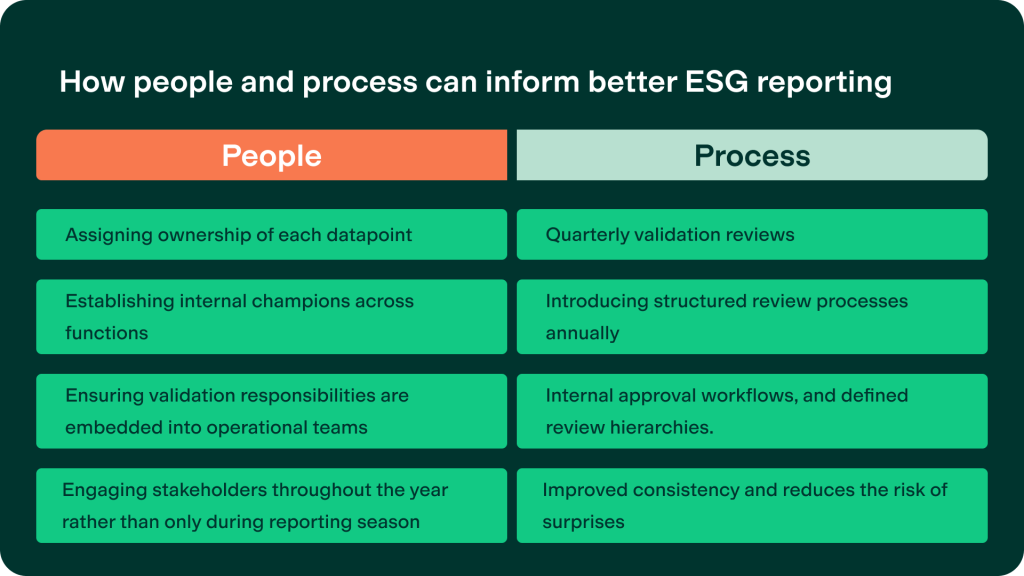
- Assigning a named owner to each datapoint
- Establishing internal champions across functions
- Ensuring validation responsibilities are embedded into operational teams
- Engaging stakeholders throughout the year rather than only during reporting season
Ownership should always be assigned to a specific individual rather than a department, ensuring that accountability is clear.
Process: structured validation throughout the reporting cycle
Even with clear ownership, ESG reporting processes can break down if validation happens only at the end of the reporting cycle.
Late-stage validation often leads to:
- Rushed corrections
- Inconsistent methodologies
- Last-minute data gaps
- Reduced confidence in final disclosures
Organizations with mature ESG reporting processes move validation earlier in the cycle.
Instead of treating validation as a year-end exercise, they introduce structured review points throughout the year.
These often include quarterly validation reviews, internal approval workflows, and defined review hierarchies.
This approach informs and enhances processes throughout the year, but truly culminates in faster and easier processes during final reporting.
Six steps to strengthen your ESG reporting process
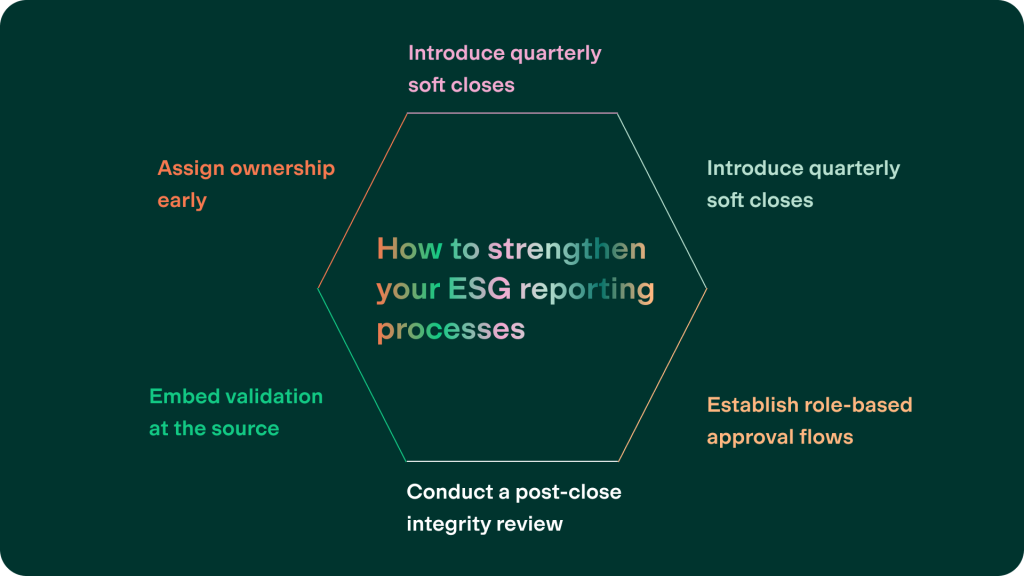
For organizations evaluating their ESG reporting workflows, here are six recommended practical steps to build stronger validation routines.
1. Assign ownership early
Every ESG datapoint should have a clearly identified owner. This helps ensure accountability for data quality and reduces confusion during validation reviews.
2. Embed validation at the source
Validation should happen when data is entered, not only during final reporting. This means embedding controls that flag unusual changes or require explanations when thresholds are exceeded.
3. Introduce quarterly soft closes
Waiting until year-end to validate ESG data increases risk. Quarterly review cycles allow teams to identify gaps early and gradually improve data quality over time.
4. Establish role-based approval flows
A structured approval chain strengthens reporting integrity. Typical ESG reporting workflows include: Data owner → reviewer → final approver. This approach ensures that validation steps are documented and traceable.
5. Conduct a post-close integrity review
Once the reporting cycle is complete, organizations should assess how well the process worked. This review helps identify weaknesses in validation routines, governance, or internal coordination
6. Close the loop with improvement actions
Reporting improvements should not stop once the report is published. Organizations should define follow-up actions and review them periodically during the following reporting cycle.
Questions to ask when evaluating your ESG reporting process
Organizations reviewing their reporting workflows can use the following questions as a starting point.
People
- Are roles and responsibilities clearly defined?
- Are internal champions engaged across departments?
- Are sustainability teams collaborating effectively with operational data owners?
Process
- Is validation continuous or limited to year-end?
- Are reporting criteria applied consistently across entities?
- Are risks and data gaps identified early in the cycle?
Platform
- Are validation controls embedded in data collection tools?
- Is there full traceability of data changes and approvals?
- Does the system support both reporting and strategic analysis?
Answering these questions helps organizations determine whether their reporting processes are reactive or structured.
Common mistakes to avoid
Even with ESG management software, organizations often fall into predictable traps:
- Assessing all suppliers equally without risk segmentation
- Overloading questionnaires with irrelevant data points
- Failing to act on high-risk findings
- Running assessments annually without ongoing monitoring
- Treating supplier assessment as a reporting task instead of a risk process
Avoiding these pitfalls strengthens both compliance defensibility and operational resilience.
The role of ESG reporting software
Many ESG reporting challenges arise from fragmented data systems. When ESG data is collected through multiple spreadsheets, organizations often struggle with:
- Manual reconciliation
- Inconsistent methodologies
- Limited traceability
- Difficulty maintaining audit trails
A centralized ESG reporting platform can help embed governance directly into the reporting process.
Strong ESG reporting software typically enables:
- Controlled workflows
- Built-in validation rules
- Automated anomaly detection
- Traceability and audit readiness
- Integration with operational systems
Instead of relying on reactive corrections at year-end, these systems enable continuous validation throughout the reporting cycle.
How AI is changing ESG reporting workflows
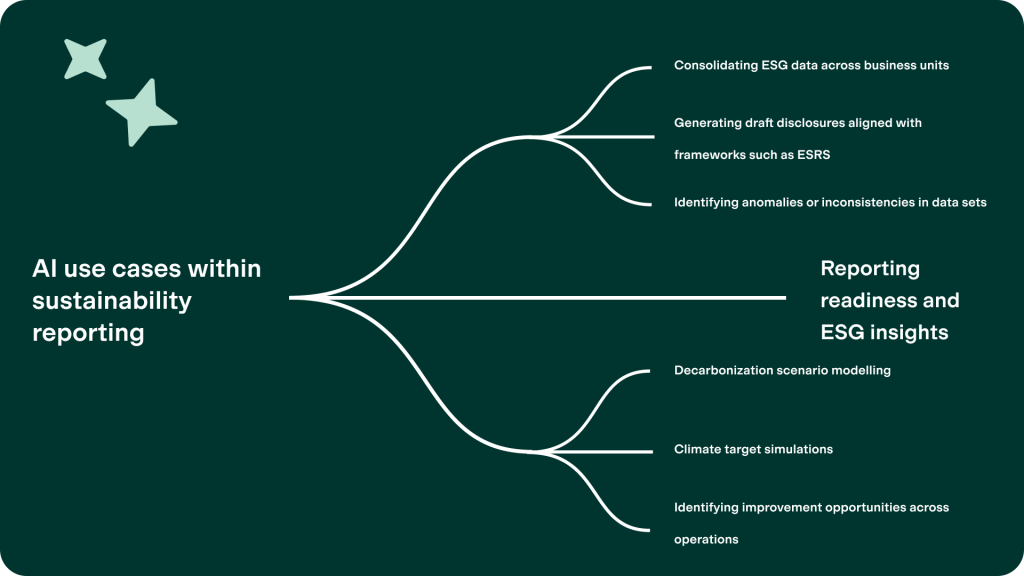
AI is increasingly being used to improve both ESG reporting efficiency and strategic insight. In reporting processes, AI can help automate tasks such as:
- Consolidating ESG data across business units
- Generating draft disclosures aligned with frameworks such as ESRS
- Identifying anomalies or inconsistencies in data sets
Beyond reporting, AI is also enabling forward-looking analysis.
Organizations are beginning to use AI-driven tools for:
- Decarbonization scenario modelling
- Climate target simulations
- Identifying improvement opportunities across operations
These tools help organizations move from validated ESG data to actionable sustainability insights.
Building a stronger ESG reporting process
As ESG reporting requirements evolve, organizations are under increasing pressure to demonstrate reliable sustainability data.
Companies that treat ESG reporting as an annual exercise often struggle with inefficiencies and credibility risks.
Organizations that invest in structured reporting processes gain several advantages:
- Stronger data confidence
- Smoother audit and assurance processes
- Faster reporting cycles
- Clearer insights for sustainability strategy
Ultimately, evaluating the ESG reporting process is not just about improving disclosures. It is about building a sustainable data infrastructure that supports better decision-making across the organization. To enhance this further requires a platform built around reporting excellence, with the collaboration tools you need to enhance people and processes within it.
Learn more about Position Green