How pharma companies can implement SBTi with confidence: from a robust baseline to feasible targets

At the same time, many biotech, health, and pharmaceutical companies face a common challenge: the largest share of emissions typically sits in the supply chain, often concentrated in purchased goods and services. This increases the complexity of target setting, given the indirect nature of influence over emissions, variability in supplier data quality, and constraints on the ability to influence suppliers across the value chain.
This article outlines a practical approach to setting SBTi targets in the Pharmaceuticals, Biotechnology and Life Sciences sector, based on proven steps that support credible decarbonization and supplier readiness.
Why pressure is rising, even as EU reporting requirements change
Even though the EU is simplifying sustainability reporting requirements, demand for climate maturity is rising across life sciences.
In practice, the strongest pressure is coming from commercial and procurement dynamics, including:
- Public tenders increasingly incorporating ESG criteria
- Customer and supplier reviews requiring emissions and target maturity
- Large pharma companies cascading SBTi and GHG requirements through value chains
This creates a new “license to operate” reality: carbon management maturity is becoming non-negotiable for suppliers, and deadlines are often short.
The pharma challenge: Scope 3 dominance and limited leverage
Pharmaceutical businesses often face a sector-typical, emissions profile:
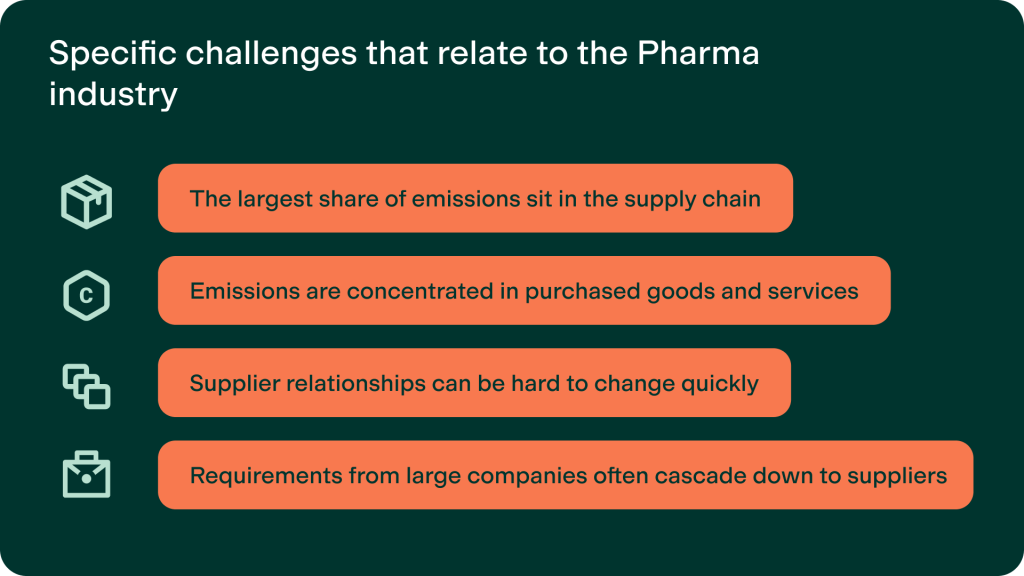
- The largest share of emissions sits in the supply chain
- Emissions are concentrated in purchased goods and services
- Supplier relationships can be hard to change quickly
- Requirements from large pharma companies often cascade down to suppliers
This is why target setting in pharma cannot be treated as a generic decarbonization exercise. The approach needs to be built around supplier emissions visibility, procurement levers, and realistic implementation pathways.

“Without a credible baseline, a solid feasibility assessment, and a realistic pathway across the entire value chain, targets can quickly become a liability or simply turn into goals that are unreachable for your team.”
Alexander Morden, Head of Life Sciences, Position Green
A structured approach to setting SBTi-aligned targets in pharma
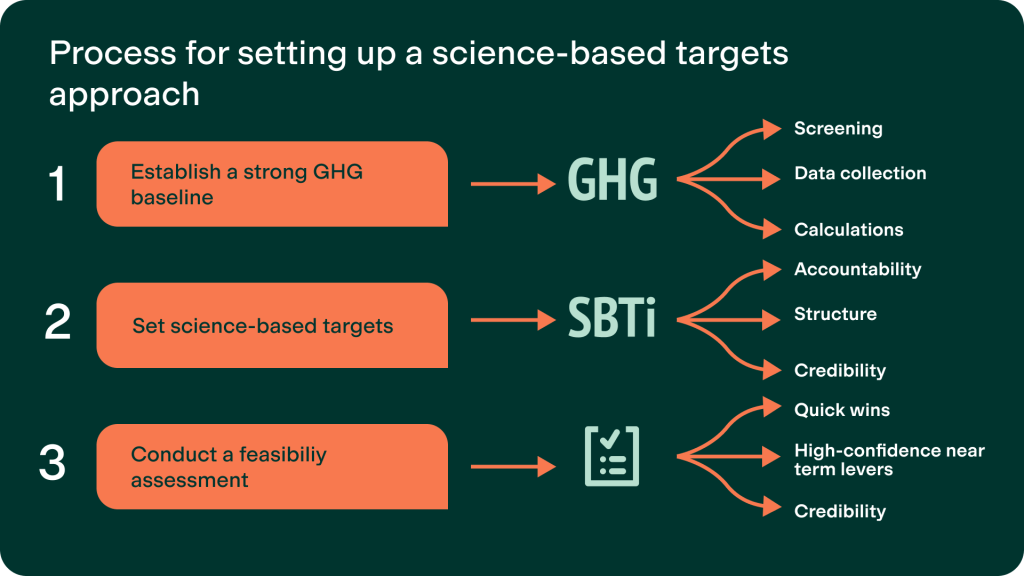
A clear three-step process supports both credibility and execution:
- Establish a strong GHG baseline
- Set science-based targets
- Conduct a feasibility assessment
This structure helps avoid a common failure mode: setting targets that are technically aligned on paper but operationally unachievable.
Step 1: Establish a strong GHG baseline
Before setting targets, companies need a GHG inventory that is reliable enough to support reporting, tracking progress, and future target setting.
A pragmatic way to demystify the process is to treat carbon accounting as an iterative maturity journey. Organizations do not need perfect data on day one. They need an approach that improves with every cycle.
A simple internal workflow can be framed as:
- Screening (identify hotspots and priority categories)
- Data collection
- Calculations
What “good” looks like in pharma baselining
For pharmaceutical companies, a GHG baseline is most valuable when it moves beyond compliance and becomes a decision-useful management tool. A robust baseline should enable leadership teams to clearly answer four critical questions:

“Find your allies internally, start with what is doable, then, move onto the more complex topics.”
Christoffer Falkman, Sustainability & ESG Director, Bavarian Nordic
- Which decisions will this baseline unlock in procurement and operations?
- Where are our Scope 3 emission hotspots across the value chain?
- Which suppliers and purchasing categories drive the majority of emissions?
- What data can we credibly collect now, and where are the most material data gaps?
Step 2: Set science-based targets as a coordination mechanism
In pharma, science-based targets are not only a climate commitment. They also become a governance mechanism to coordinate action across the value chain.
A strong target framework helps create:
- Accountability
- Structure
- Credibility
This is especially relevant in pharma supply chains, where decarbonization often requires coordinated action across key service providers such as contract research and manufacturers organizations, raw material and packaging suppliers, and logistics.
Why SBTi? A question we often hear from clients is why we encourage the use of SBTi as the targets to shoot for. While it is certainly the case that other science-based targets exist, these have been the gold standard for pharmaceutical industry players for a while, giving you a common language to communicate as part of tender agreements or engagements with suppliers.
Step 3: Run a feasibility assessment before locking targets
This is the step that many companies skip, and it is often where execution risk becomes visible.
A feasibility assessment should break decarbonization levers into three buckets:
- Quick wins
- High-confidence near-term levers
- Large investments
This helps avoid a strategy gap where targets exist but delivery plans do not.
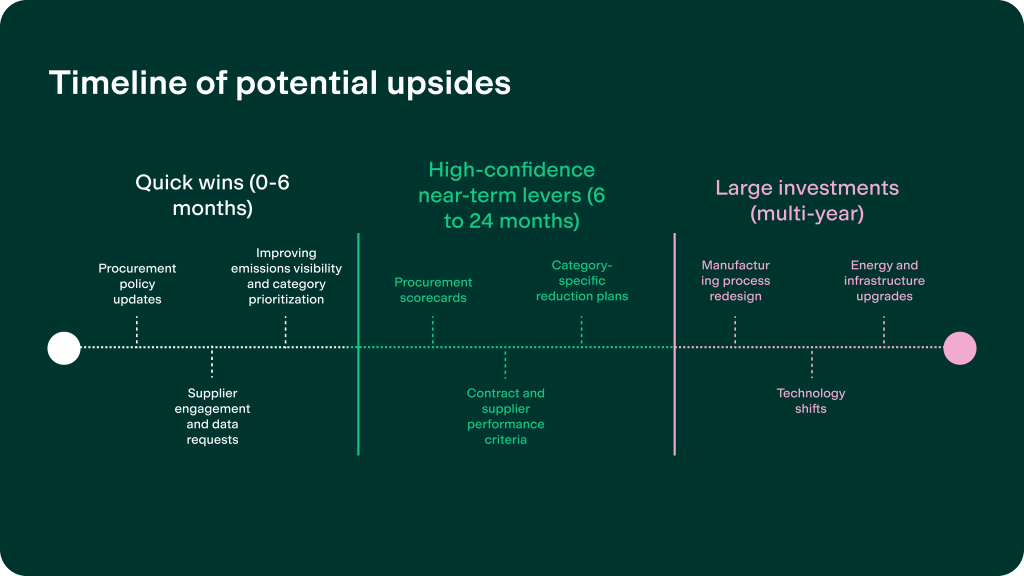
Quick wins (0 to 6 months)
These are actions that can be executed fast with limited capital, often driven by:
- Procurement policy updates
- Supplier engagement and data requests
- Improving emissions visibility and category prioritization
High-confidence near-term levers (6 to 24 months)
These levers are realistic within standard planning cycles and may include:
- Procurement scorecards
- Contract and supplier performance criteria
- Category-specific reduction plans
Large investments (multi-year)
These require leadership alignment, budget allocation, and long-term planning, including:
- Manufacturing process redesign
- Technology shifts
- Energy and infrastructure upgrades
The real risk: market access, not just emissions
The business consequences of falling behind are already clear in pharma supply chains.
When suppliers cannot deliver against GHG and SBTi expectations, organizations risk:
- Disqualification in tenders
- Losing existing contracts
- Inefficient use of resources due to firefighting
- Lower data accuracy and reduced ability to meet targets
This is why SBTi-aligned target setting should be treated as a commercial readiness program, not only a sustainability program.
Progress matters more than perfection
Pharma companies are often hesitant to act because of uncertainty, imperfect data, and evolving standards. But setting targets is not an act in isolation, it is a constant state of progress. Progress is the key word here as that is what matters most, both in auditor conversations, and in tender discussions. If you can demonstrate progress, even if not perfect, you’re doing well.

“Carbon management does not require perfection. It requires direction, consistency and collaboration.”
Antonella Cistari, Advisory Associate, Position Green
Companies now have stronger foundations than a few years ago, including:
- Clear frameworks
- Better data availability
- Stronger business incentives
- Growing momentum
What to do next: a practical checklist
If you are a pharma business setting SBTi-aligned targets, your next actions should be:
- Build a defensible baseline that identifies hotspots, especially in Scope 3 purchased goods and services
- Define targets that support coordination across the value chain
- Run a feasibility assessment across quick wins, near-term levers, and long-term investments
- Align governance across sustainability, procurement, and operations
- Establish a supplier engagement plan that supports data improvement and target delivery
Don’t wait for the right time to set targets
All of the above is something we can help you with at Position Green, both with our complete ESG management platform and our team of advisors with proven track records of helping fellow pharmaceutical businesses align their sustainability with their strategic goals. If you want to learn how we can help you do the same, we’re just one click away.
Chat with us
Antonella Cistari
Advisor
Position Green