How to build a sustainability business case that actually holds up
Sustainability initiatives often compete with other investments for budget, attention, and priority. When when they are evaluated, they are usually judged on one thing: return on investment (ROI).
But this is where many business cases fall short, and in this article, you’ll learn why judging sustainable investments on face value can prevent you from seeing the full ROI picture.
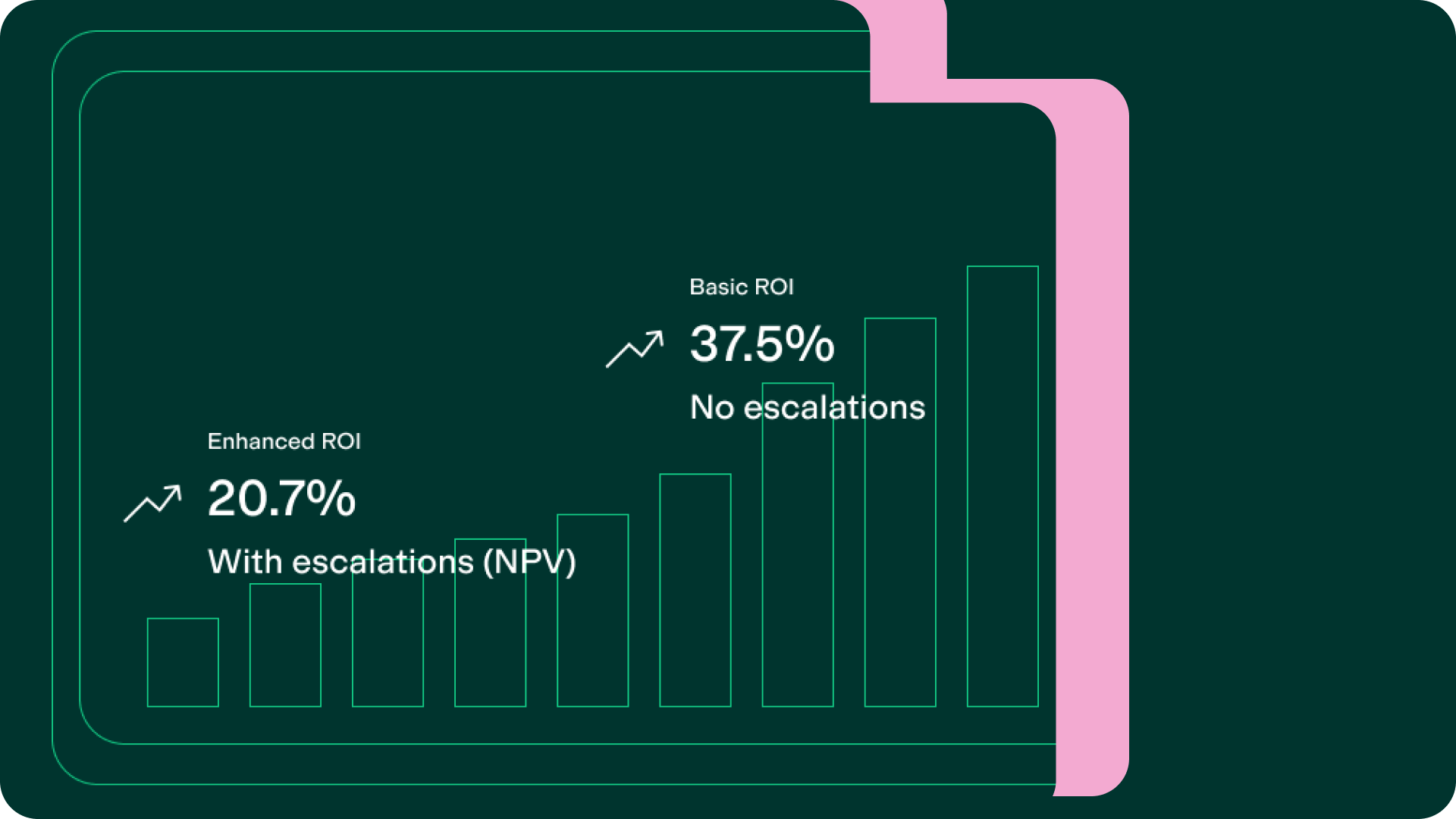
The problem with how ROI is used in sustainability
Most sustainability business cases start with direct financial effects. These are the most visible and easiest to quantify. For example:
- Reduced energy consumption leading to lower costs
- Efficiency gains in operations
- Reduced material usage
These effects are tangible, immediate, and fit neatly into traditional financial models. However, they only represent a portion of the value created. A large share of sustainability’s impact sits in indirect financial effects. These are second-order impacts that influence the company’s financial position without appearing as a line item in a simple cost-saving calculation.
These include:
- Risk reduction: Lowering exposure to regulatory penalties, supply chain disruption, or stranded assets
- Cost of capital: Improved ESG performance can influence lending conditions, interest rates, or investor appetite
- Access to funding: Eligibility for green financing instruments or sustainability-linked loans
- Market positioning: The ability to retain or win customers who prioritize sustainability
- Workforce dynamics: Improved retention, reduced hiring costs, and stronger employer branding
These effects are harder to isolate and quantify, which is why they are often excluded. But leaving them out creates a distorted picture.
A business case built only on direct effects may significantly underestimate the total value of an initiative, making strong investments appear marginal or unattractive.
Why strong decisions often have weak business cases
There is a structural mismatch between how sustainability decisions are made and how they are evaluated.
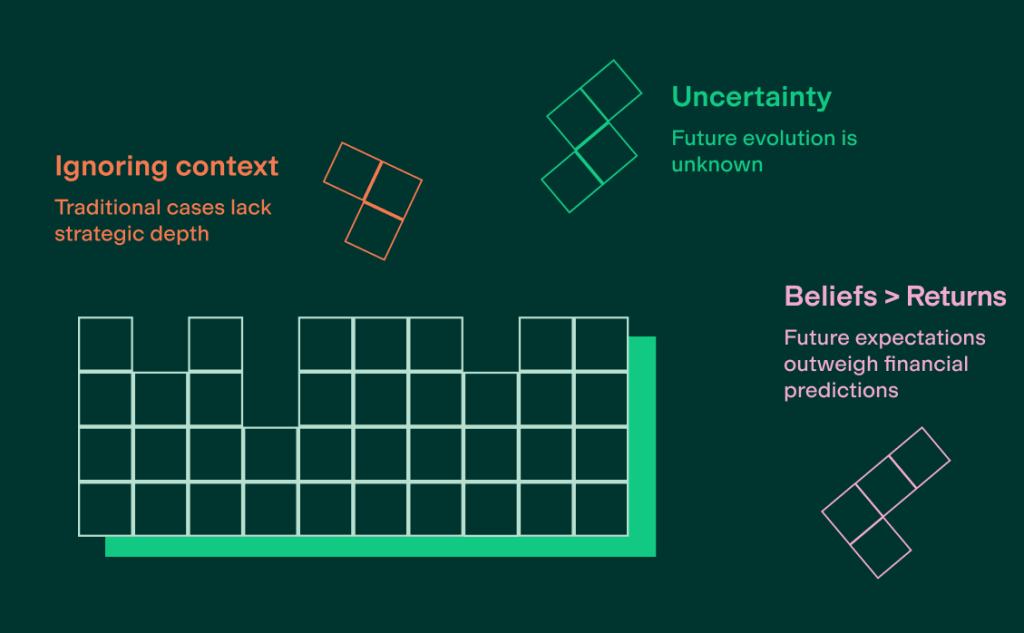
Most strategic decisions are not made purely on quantified returns. They are based on expectations about how the business environment will evolve.
For example:
- Will customers increasingly demand sustainable products?
- Will regulatory requirements tighten?
- Will investors price sustainability risk more aggressively?
These are not certainties. They are beliefs about the future that often carry more weight than the immediate financial return.

“You should never let a bad business case stand in the way of a good decision.”
Anders De Lichtenberg, Global Head of Advisory, Position Green
This does not mean ignoring financial discipline. It means recognizing that traditional business cases often fail to capture the full strategic context.
Start with the value case, not the ROI
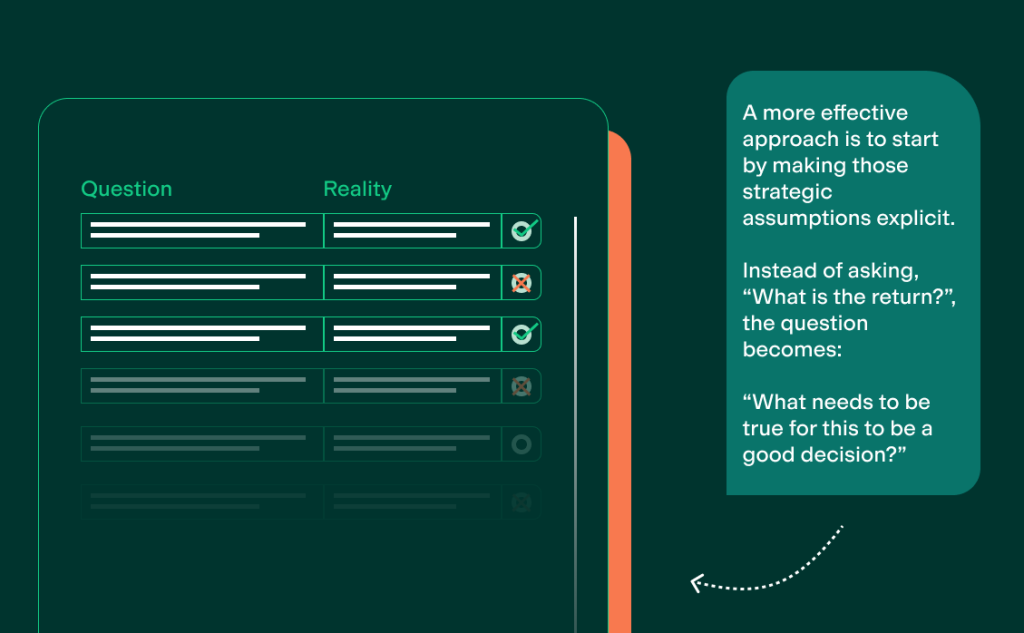
A more effective approach is to start by making those strategic assumptions explicit. Instead of asking, “What is the return?”, the question becomes:
“What needs to be true for this to be a good decision?“
For example:
- Do we believe this will reduce our risk profile?
- Do we believe it will improve access to funding?
- Do we believe it will strengthen our position with customers or employees?
These are the underlying drivers of value. They may not be precise, but they are grounded in real business dynamics.
By articulating these assumptions clearly, companies create a value case, i.e., a structured explanation of why the investment makes sense beyond immediate financial returns.
Then use ROI to pressure test the case
Once the value case is defined, ROI becomes a tool for validation. At this stage, the purpose of ROI is not to prove that the investment is attractive in isolation, but to test whether it is financially defensible.
The question becomes:
If our strategic assumptions do not fully materialize, does this still make sense?
This involves:
- Calculating direct financial returns
- Incorporating measurable indirect effects where possible
- Stress-testing assumptions
If the investment holds up under this scrutiny, it becomes more robust. It is no longer dependent on best-case scenarios. Instead, it demonstrates resilience under uncertainty.
The overlooked impact of indirect value
When indirect effects are incorporated, the financial profile of sustainability initiatives often changes significantly.
Consider a simple example. An energy efficiency investment may initially appear to generate modest savings through reduced energy costs.
But when additional factors are included, the picture evolves:
- Reduced exposure to future carbon pricing
- Improved eligibility for green financing
- Lower perceived risk by lenders
- Enhanced attractiveness to customers or partners
Each of these elements may contribute incrementally. Together, they can materially increase the overall value of the investment.
In some cases, the total value can be several times higher than what is captured through direct cost savings alone. This is not because the initial calculation was incorrect, but because it was incomplete.
Why ROI should be the fallback, not the headline
One of the more important shifts is understanding the role of ROI in the decision-making process.
ROI is often treated as the primary argument. In practice, it functions better as a safeguard. If an investment only makes sense under optimistic assumptions, it is fragile.
If it remains financially sound even under conservative assumptions, it becomes significantly more credible. In this sense, ROI provides a baseline.
It answers the question:
Are we at least not making a bad decision?
The strategic value then answers a different question:
Are we making the right decision?
Separating these two roles helps clarify the discussion and avoid overloading ROI with expectations it is not designed to meet.
From cost discussion to strategic decision
The way a business case is structured determines the type of conversation it creates.
A narrow ROI-driven approach leads to a cost-focused discussion:
- What does this cost?
- How quickly do we recover it?
A value-led approach broadens the discussion:
- What risks are we reducing?
- What opportunities are we enabling?
- How does this position the business over time?
This shift is particularly important in sustainability, where many benefits unfold over longer time horizons and interact with broader market dynamics.
Why you need an ROI calculator for sustainability
Most tools in sustainability focus on reporting, compliance, or data collection, with limited oversight on strategic opportunities that can be found within those processes. Fewer tools address the challenge of building a robust business case, as they are too generic to accommodate for the breadth of data found in sustainability initiatives.
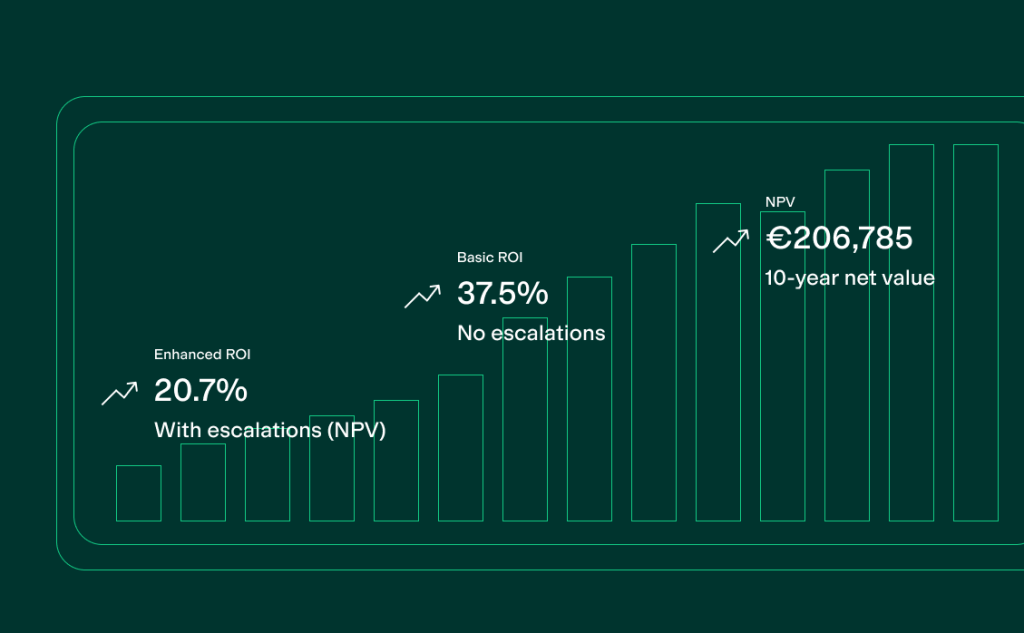
Position Green’s ROI calculator was developed to support this process.
It allows companies to:
- Structure both direct and indirect financial effects
- Explore how sustainability influences risk and financing
- Build a more complete and transparent investment case
Rather than replacing strategic thinking, it provides a way to connect strategic assumptions with financial logic.
This makes it easier to communicate decarbonization initiatives internally, particularly in environments where decisions are evaluated against competing priorities.
Building better sustainability decisions
Sustainability is increasingly integrated into core business strategy.
However, the way it is evaluated often remains anchored in traditional financial models.
Expanding the scope of analysis to include indirect effects and strategic drivers provides a more accurate representation of value.
By starting with a clear value case and using ROI as a validation tool, companies can build business cases that reflect both the financial and strategic dimensions of sustainability.
This is what allows sustainability to move from a difficult justification to a structured and defensible decision.
Try the ROI calculator
If you are working to build or strengthen a sustainability business case, the next step is to test it.
Use the ROI calculator to:
- Explore the full financial impact of your decarbonization initiatives
- Include both direct and indirect effects
- Pressure test your assumptions with real numbers
It is designed to support the way sustainability decisions are actually made, by combining strategic logic with financial validation.
Try the calculator