ESG and sustainability reporting software in 2026: How leading platforms compare

Verdantix defines ESG and sustainability reporting software as solutions that allow businesses to collect, analyze and manage ESG information, drive sustainability performance, and report to mandatory and voluntary standards across environmental and social issues, within an enterprise and across the value chain. This definition aligns with the framework outlined in the 2025 Verdantix Green Quadrant report on ESG & Sustainability Reporting Software.
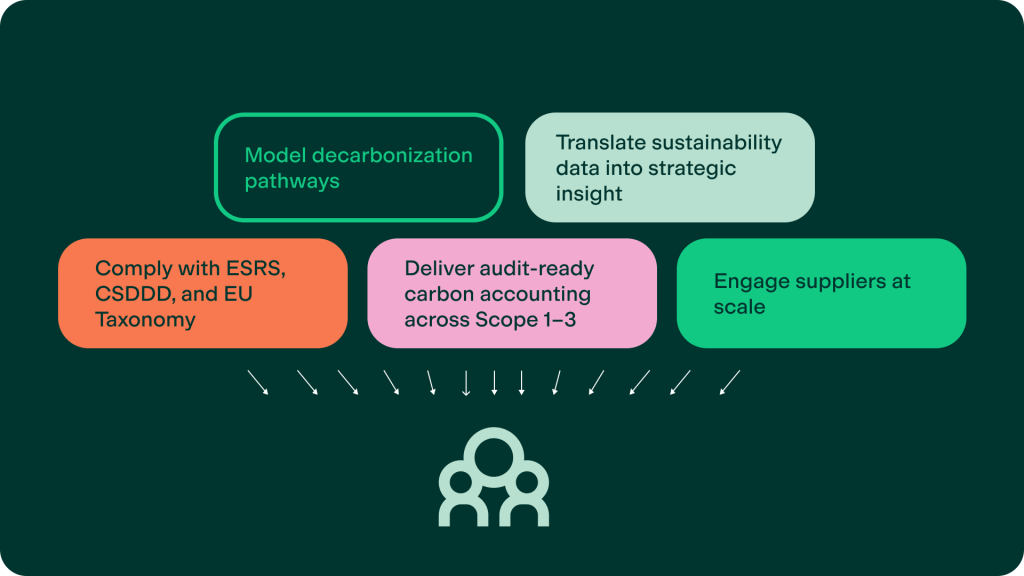
As CSRD, CSDDD, EU Taxonomy and global climate disclosure requirements reshape expectations, organizations increasingly need platforms that combine compliance, performance management and value chain integration.
How to assess ESG management software in 2026
The question is no longer whether a platform can collect emissions data. The question is whether it can operationalize sustainability across reporting, risk, value chain and strategy.
Based on analyst research and buyer trends, five areas are particularly important.
1. Regulatory specialization
Does the platform provide structured support for:
- ESRS reporting
- EU Taxonomy alignment
- CSDDD due diligence
- Regulated and non-regulated frameworks
Generic ESG templates often require heavy customization. Dedicated regulatory modules reduce interpretation risk and improve audit readiness.
2. Data architecture, workflows and auditability
ESG controllers and finance teams increasingly require:
- Structured data acquisition across entities
- Clear validation and approval workflows
- Full audit trails
- Cross-framework mapping
- Configurable organizational structures
Software should ensure that sustainability data meets the same integrity standards as financial data.
3. Carbon depth beyond measurement
Scope 1 to 3 accounting is baseline. Buyers should also assess:
- Scope 3 methodology flexibility
- Supplier-specific data integration
- Decarbonization modelling
- Scenario planning
- Target-setting and visualization tools
Carbon accounting without reduction modeling limits strategic impact.
4. Supplier and value chain enablement
With CSDDD and Scope 3 requirements expanding, platforms should support:
- Supplier data collection portals
- Engagement tools
- Evidence documentation
- Risk scoring
- Repeatable due diligence workflows
Spreadsheets and email-based collection processes do not scale.
5. Performance management and benchmarking
Leading organizations are moving beyond reporting toward performance forecasting. This includes:
- Sustainability performance management dashboards
- Internal benchmarking across sites and business units
- External benchmarking against peers
- Forecasting and scenario analysis
Software is increasingly expected to support decision-making, not just compliance.
Vendor assessments
Plan A
Core orientation: Carbon accounting and decarbonization strategy with European regulatory positioning.
Plan A built its foundation around carbon measurement and reduction planning. The platform supports Scope 1, 2 and 3 accounting and integrates decarbonization modeling, target-setting and transition planning. It positions itself strongly within the European regulatory landscape, including CSRD alignment narratives.
Functional strengths
- Structured carbon accounting workflows
- Reduction pathway modeling and science-based target alignment
- Data visualization for emissions hotspots
- Supplier emissions estimation methodologies
Typical customer profile: Mid-market to upper mid-market organizations formalizing carbon programs for the first time, particularly those with investor or regulatory pressure to disclose emissions data.
Considerations
- Depth across broader ESG topics such as social indicators and governance metrics should be evaluated
- Regulated framework mapping granularity for full ESRS implementation may require validation
- Supplier due diligence workflows beyond emissions collection may not be the primary strength
Plan A is often selected where carbon is the strategic entry point and regulatory alignment is emerging.
Watershed
Core orientation: Climate program execution and Scope 3 activation.
Watershed positions itself as an end-to-end climate platform supporting emissions measurement, supplier engagement and decarbonization initiatives. It emphasizes audit-grade carbon accounting and value chain collaboration.
Functional strengths
- Scope 3 categorization and supplier-specific data collection
- Engagement tools for supplier emissions reduction
- Carbon reduction project tracking
- Analytics and emissions hotspot identification
Typical customer profile: Large enterprises with significant Scope 3 exposure, often in consumer goods, technology or retail sectors where supplier engagement is critical.
Considerations
- Breadth across non-climate ESG reporting areas should be evaluated
- Structured ESRS datapoint mapping and double materiality workflows may require review
- Governance, approval and auditability tooling should be assessed for highly regulated environments
Watershed is frequently chosen when Scope 3 management is the dominant sustainability challenge.
Workiva
Core orientation: Governance, controls and financial-grade reporting integrity.
Workiva extends its financial reporting and GRC capabilities into ESG reporting, offering strong workflow management, version control and audit readiness.
Functional strengths
- Structured approval workflows
- Cross-functional collaboration between finance and sustainability teams
- Framework mapping across multiple standards
- Robust data controls and audit trails
Typical customer profile: Listed enterprises and organizations with mature finance functions requiring ESG data to meet assurance standards equivalent to financial reporting.
Considerations
- Native carbon modeling and reduction pathway depth should be evaluated
- Supplier engagement and due diligence functionality may require complementary systems
- Performance forecasting tools may not be as climate-focused as carbon-native platforms
Workiva appeals to governance-driven organizations prioritizing data integrity.
Sphera
Core orientation: Enterprise sustainability management with EHS integration.
Sphera offers one of the broadest capability sets in the market, combining sustainability reporting with EHS, lifecycle assessment and supply chain risk management.
Functional strengths
- Advanced Scope 3 accounting and lifecycle analysis
- Strong configurability and data architecture
- Integration across EHS, product stewardship and sustainability
- Enterprise scalability and global presence
Typical customer profile: Large industrial and asset-intensive organizations requiring integration across operational risk and sustainability functions.
Considerations
- Platform complexity may result in longer implementation timelines
- User interface simplicity for non-technical ESG teams should be evaluated
- Organizations focused purely on reporting rather than operational integration may find functionality extensive
Sphera is often selected by complex multinational enterprises.
Sweep
Core orientation: Carbon-first platform expanding into integrated ESG reporting.
Sweep has evolved beyond carbon accounting to incorporate broader sustainability management and disclosure capabilities. It supports forecasting and scenario analysis for decarbonization.
Functional strengths
- Forecasting and scenario modeling for emissions
- Integrated sustainability data dashboards
- Growing global customer base
- Supplier emissions tracking
Typical customer profile
Growth-stage and multinational companies seeking modern UX and carbon-forward reporting tools.
Considerations
- Depth of ESRS-specific workflows should be validated
- Audit and assurance workflow maturity should be reviewed
- Breadth across social and governance topics should be assessed
Sweep appeals to organizations prioritizing climate strategy with expanding ESG needs.
osapiens
Core orientation: Regulatory compliance and value chain due diligence.
The osapiens HUB provides modular compliance capabilities, particularly in supply chain transparency and due diligence contexts.
Functional strengths
- Regulatory interoperability across compliance domains
- Supply chain traceability
- Risk assessment modules
- Modular architecture supporting expansion
Typical customer profile: Organizations navigating complex regulatory obligations across product and supply chains.
Considerations
- ESG performance management and benchmarking maturity should be assessed
- Carbon modeling and reduction planning depth should be validated
- Usability for pure sustainability reporting teams should be evaluated
osapiens is often selected when regulatory consolidation is a primary objective.
Stratsys
Core orientation: Governance-led sustainability management and reporting.
Stratsys integrates CSRD reporting support with due diligence workflows and structured governance processes.
Functional strengths
- Double materiality support
- Reporting governance tools
- Risk-based supplier assessment
- Structured sustainability management
Typical customer profile: Nordic and European organizations emphasizing governance alignment and regulatory structure.
Considerations
- Advanced decarbonization modeling should be assessed
- Scope 3 supplier emissions engagement capabilities should be reviewed
- External benchmarking sophistication should be evaluated
Stratsys aligns well with governance-focused sustainability programs.
CEMAsys
Core orientation: Carbon accounting combined with advisory support.
CEMAsys focuses on structured Scope 1 to 3 accounting, often supported by consulting expertise.
Functional strengths
- Multi-entity emissions consolidation
- Structured carbon reporting
- Advisory-supported implementation
Typical customer profile: Mid-market to enterprise organizations establishing carbon baselines and requiring methodological support.
Considerations
- Broader ESG topic coverage should be evaluated
- Supplier sustainability engagement depth should be reviewed
- Benchmarking and forecasting capabilities should be assessed
CEMAsys is often selected for carbon-first programs supported by advisory expertise.
Normative
Core orientation: Supplier-driven carbon accounting and reduction modelling.
Normative emphasizes Scope 3 data accuracy and supplier engagement.
Functional strengths
- Supplier-specific emissions data collection
- Carbon hotspot identification
- Reduction pathway modeling
Typical customer profile: Organizations with procurement-led sustainability strategies and strong climate ambitions.
Considerations
- ESRS reporting workflow depth should be validated
- Governance and auditability tooling should be assessed
- Broader ESG coverage beyond carbon should be evaluated
Normative appeals to climate-focused organizations prioritizing supplier emissions accuracy.
Persefoni
Core orientation: Audit-grade carbon accounting for investor disclosures.
Persefoni focuses on financial-grade carbon data and regulatory disclosure readiness.
Functional strengths
- Structured emissions accounting
- Disclosure-ready reporting outputs
- Alignment with climate disclosure expectations
Typical customer profile
Organizations facing investor scrutiny or climate disclosure mandates.
Considerations
- Breadth across non-climate ESG topics should be assessed
- Supplier sustainability workflows should be evaluated
- Benchmarking and sustainability performance management depth should be reviewed
Persefoni is often shortlisted when carbon disclosure integrity is the primary objective.
Position Green
Position Green is designed as an integrated ESG system connecting regulatory compliance, carbon management, supplier sustainability and performance insight within one platform.
The platform includes dedicated solutions for ESRS reporting, EU Taxonomy alignment, CSDDD due diligence, Carbon Accounting and Supplier Assessment. AI is embedded across the suite to support ESRS mapping, disclosure drafting, anomaly detection, supplier analysis, benchmarking and performance insights.
Beyond compliance, Position Green supports decarbonization modeling, forecasting and scenario analysis, enabling organizations to transition from data collection to sustainability performance management.
Combined with in-house advisory expertise across European regulatory frameworks and carbon methodology, the platform is designed to reduce compliance risk while consolidating ESG management into a unified, AI-enhanced system.
Chat with us
Daniel Schermerhorn
Product Marketing Manager
Position Green