Emission factors explained in 3 minutes

To understand how companies calculate greenhouse gas emissions, it’s essential to understand emission factors.
What are emission factors?
An emission factor is a representative value that quantifies the greenhouse gas emissions associated with a specific activity, product or process. Emission factors are central to carbon accounting because they translate measurable activity data, such as kWh of electricity or liters of fuel, into CO₂e emissions.
In practice, an emission factor is multiplied by activity data to calculate total emissions. For example, electricity consumption or fuel combustion can be converted into CO₂e by applying the appropriate emission factor.
Why are emission factors important?
Emission factors are crucial for companies as they provide a standardized way to calculate and report the amount of GHGs produced from various activities. This enables companies to accurately assess their climate impact, comply with regulations, set reduction targets, and communicate their sustainability efforts to stakeholders, ultimately enhancing their environmental responsibility and corporate reputation.
Carbon dioxide equivalents and global warming potential
Emission factors are commonly described by CO₂e, regulated based on Global Warming Potential values defined by the IPCC Sixth Assessment Report (AR6), making the data comparable across a range of harmful GHGs, and not only CO2. The unit is generally measured in metric tonnes and includes both the impact and the relative global warming potential (GWP) of all GHGs.
This warming potential of a greenhouse gas is defined by a value index of the Intergovernmental Panel on Climate Change (IPCC), indicating the potency and global warming effect of a gas over a set period of time, most commonly calculated over 100 years (GWP100). Carbon dioxide (CO2) is used as a reference point of 1 GWP, where for instance methane (CH4) has a GWP value of 28, meaning that 1 tonne of methane has the same warming effect as 28 tonnes of CO2.

“Reliable carbon accounting requires a standardized approach that vets all aspects contributing to the final data.”
Amélie Huart – Managing Director – Denmark & DACH, Position Green
How are emission factors used to calculate emissions?
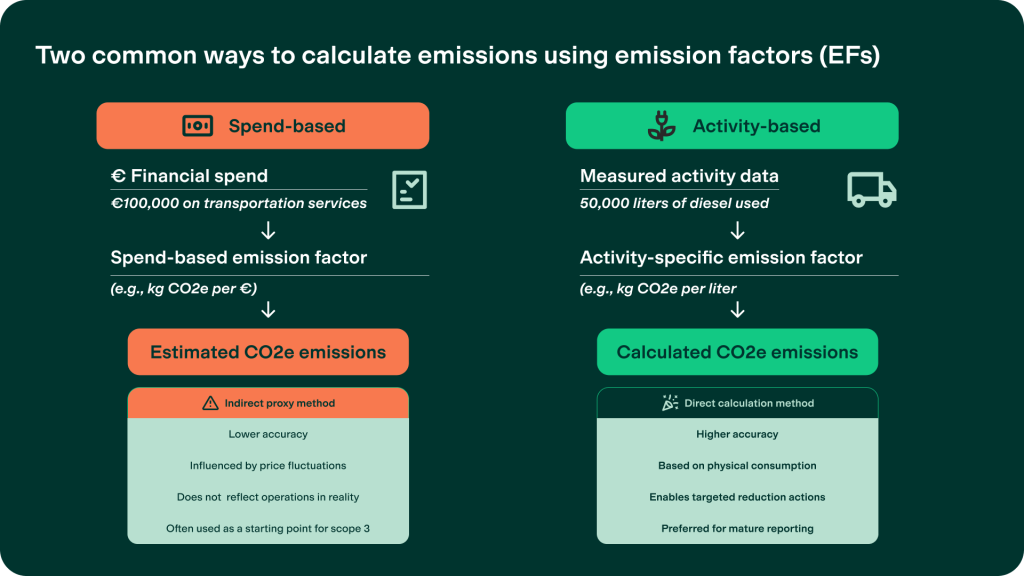
While emission factor are an integral part of calculating the climate impact of a product or process, they must be used in combination with data provided by the reporting company, specifying the energy usage, distance travelled, fuel consumption or other relevant data relating to that activity. Multiplying this activity data by the corresponding emission factor provides an estimate of the amount of CO2e released. For example, if your company used 1,000 gallons of diesel fuel, you multiply this by the diesel emission factor to get total emissions.
If activity data is unavailable, spend-based data and emission factors are used. In this case, you use the financial expenditure on activities (e.g., money spent on transportation) and apply an emission factor that correlates spending with emissions. While this method is a common starting point – especially for Scope 3 calculations where data is generally more difficult to collect – it is significantly less accurate due to price fluctuations, discounts, and other financial factors that do not directly correspond with the actual quantity of emissions produced. This indirect relationship introduces greater uncertainty and potential inaccuracies in the emission estimates.
Where can emission factors be found?
Open-source databases provided by bodies such as the IPCC or governmental agencies like DEFRA or EPA are common sources used to access EFs. There are also licensed datasets of more complex emission factors, such as IEA or Ecoinvent. Databases can be divided by industry or they can provide a broader range covering emission factors for a typical GHG reporting.
These databases also provide methodologies to outline how the emission factor has been calculated and what is included in the factor to determine its usage, i.e. either supporting a supplier-specific, average-data or spend-based method, and what lifecycle activities that are included in the factor. Databases are usually updated annually as the emission factors are subject to continuous change. For example, electricity factors change due to the amount of total production and the electricity mix (share of fossil vs renewables) during the year.
Quality assurance is a must
Reliable carbon accounting requires a standardized approach that vets all aspects contributing to the final data. Position Green’s team of experts monitors the emission factor sources for annual updates, reviewing the attached methodology for any major changes. The data is then mapped and harmonized to align with Position Green’s defined emission factor library structure. Following quality assurance testing, sensitivity analysis and the documenting of key changes to maintain a clear audit trail, the emission factors are then implemented in the customer’s carbon accounting software setup.
Want to see smart carbon accounting in action?
Position Green can help you measure, report and reduce GHG emissions across all scopes and build your climate strategies on rock-solid data.
Schedule a demo
Amélie Huart
Managing Director – Denmark & DACH
Position Green