


Gross vs net: Why Omnibus just changed how you score your own impacts

The assessment doesn’t let you say so. That disconnect had a name, gross vs net, and under the Omnibus simplification, the rules around it have just changed. Here’s what gross and net actually mean, how the change affects your assessment and your reporting, and why your auditors, your ERM colleagues, and your board will all care.

“For the first time, companies can factor in the mitigation actions and governance they’ve already implemented when scoring a negative impact, rather than assessing it as if that work had never happened.”
Sam Dresner Barnes, Associate Manager, Position Green
What a DMA is actually for
A double materiality assessment (DMA) is the process of working out which sustainability topics matter to your business, either because your business affects people or the environment (impact materiality), or because a sustainability issue affects your business’s finances (financial materiality), or simply because it is material information for your stakeholders. Any of those three, even as individual scopes, is enough to make a topic reportable.
It’s easy to treat the DMA as a compliance exercise that exists purely to justify what goes into the sustainability statement. That undervalues the exercise. Done properly, the DMA is a prioritisation tool: it tells you where your negative impacts are most severe, where your financial exposure is greatest, and therefore where management attention, budget, and mitigation effort should actually go. A good DMA feeds risk registers, informs supply chain decisions, and gives the board an overview of what really matters, long before any of it becomes a disclosure. The reporting output is a byproduct of a good DMA, not the point of it.
That framing matters for everything that follows, because gross vs net is fundamentally a question about how honestly the DMA reflects the real, current state of your operations, not just how they appear individually across separate metrics.
What gross and net actually mean
Strip away the ESRS language and this is a familiar concept. Think of your salary: your gross salary is the full amount before tax and deductions; your net salary is what actually lands in your account after they’re applied. Same number, two different points in the calculation, before an adjustment and after it.
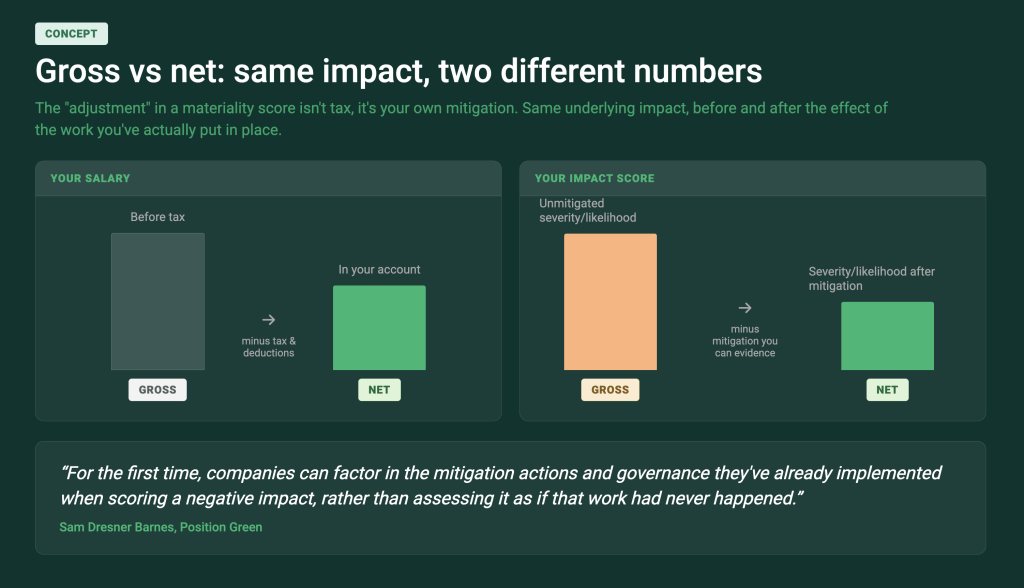
In a materiality assessment, the “adjustment” isn’t tax, it’s your own mitigation. When you score a negative impact:
• A gross score reflects the impact as if none of your prevention or mitigation work existed. It’s the raw, uncontrolled severity.
• A net score reflects the impact as it stands today, after the effect of the policies and actions you’ve actually put in place.
Same underlying impact; the question is whether your score gives your own mitigation work any credit.
Why this used to cause so much frustration
Under the original ESRS, companies had to assess impacts on a gross basis. In practice, this meant you couldn’t factor in anything you were already doing to prevent or reduce a negative impact when you scored its likelihood, even if that work was extensive, well-evidenced, and demonstrably effective.
This landed badly for two reasons. First, it was demoralising: teams that had spent years reducing a genuine impact watched it come out of the DMA looking exactly as severe as if they’d done nothing at all. Second, and more structurally, it clashed with how most companies already manage risk.
Enterprise risk management (ERM) frameworks routinely score both gross and net risk side by side, as long as the two are clearly labelled and kept distinct: gross to show the scale of the underlying exposure, net to show what’s actually left after controls. A gross-only DMA couldn’t align with that model. It forced sustainability teams to run a parallel, disconnected scoring logic from the rest of the business’s risk function, undermining the standard’s own recommendation that the DMA be integrated with existing risk management.
What this looks like in practice
Severity in a DMA isn’t one number, it’s built from three components (scale, scope, and how reversible the impact is), plus likelihood for potential impacts. Mitigation rarely improves all of them evenly. The more useful discipline, and the one that holds up under audit, is showing exactly which component an action changed and why.
Take a manufacturer whose wastewater, containing dyes and industrial chemicals, is discharged into nearby rivers, harming aquatic life and downstream communities. Before any action, every dimension of the impact scores high. Four separate actions were then implemented, each aimed at a different part of the problem:
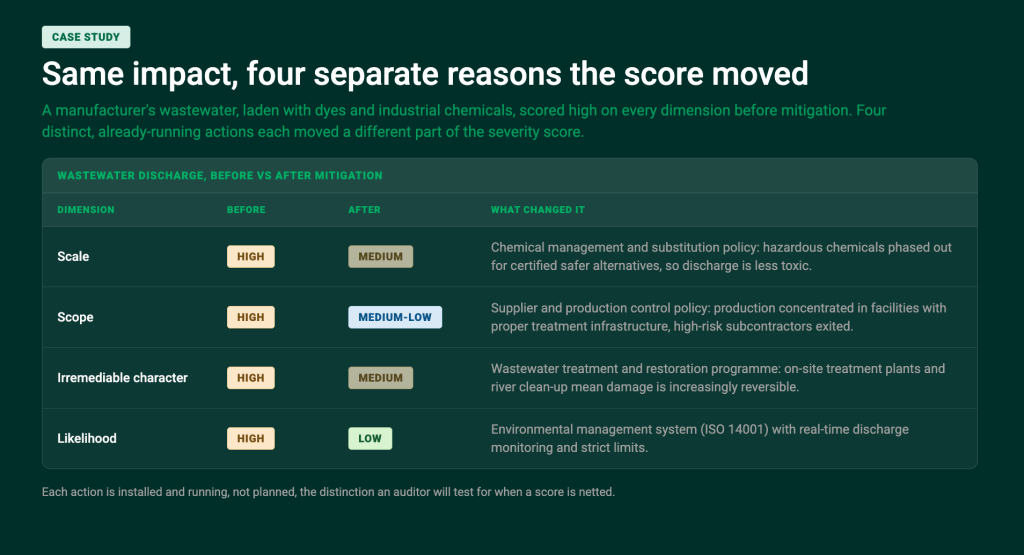
Notice what each action has in common: it’s installed and running, not planned. That distinction is exactly where the other side of this shows up: two cases where a company had policies in place and still couldn’t move the score.
Implemented, but not effective. A global electronics brand sourcing from contract manufacturers has workers regularly doing 60 to 80 hour weeks. The company has a supplier code of conduct capping hours, annual audits, corrective action plans, and a worker hotline, all genuinely in place.
None of it earns a lower score. Overtime remains widespread, audits are periodic enough to be anticipated, and corrective action plans don’t guarantee follow-through. The company’s own assessment put it plainly: a code of conduct is not enforcement, an audit is not systemic change, and a corrective action plan is not proof anything actually happened. Scale, scope, and likelihood all stay high, because the root cause, pricing and delivery pressure passed down the supply chain, was never addressed.
Not yet implemented. A fuel-systems manufacturer faces a harder end-of-life problem: some of its composite materials are difficult to recycle at commercial scale. The company can point to durability-focused product design, customer disposal guidance currently being drafted, a commissioned recycling feasibility study, and a 2030 circularity target.
None of it reduces the score, because none of it is operating yet. A study, a target, and a draft guidance document are precisely the kind of forward-looking commitments a potential impact is not allowed to be netted against.
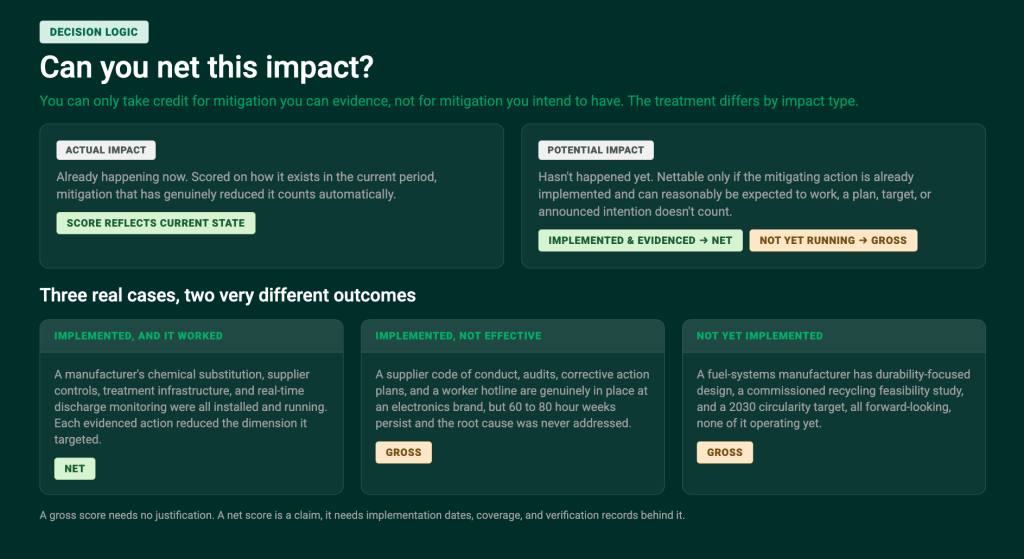
Both cases land in the same place, gross, for different reasons: one because the mitigation doesn’t work, the other because it doesn’t exist yet. Either reason should stop a net score in its tracks, and both are exactly what an auditor will test for. A gross score needs no justification; a net score is a claim, and it needs implementation dates, coverage, and verification records behind it, not a policy sitting in a drawer. Companies moving to net scoring should expect their evidence trail, not just their conclusion, to be the point of audit interest.
How this changes your reporting
The shift to net scoring doesn’t just change a number in the assessment, it changes what shows up in the sustainability statement in two connected ways.
• Fewer material IROs. Some impacts, risks, and opportunities that cleared the materiality threshold on a gross basis will now fall below it once genuine, evidenced mitigation is factored in. That’s a real reduction in reporting volume, not a loophole: it reflects mitigation that has actually happened.
• A tighter link between impacts and actions. Every impact, risk, or opportunity reported on a net basis needs the mitigating action that justified the netting to appear alongside it in the disclosure. This is arguably the more valuable change: it forces the sustainability statement to read as a coherent story, here is the impact, here is what we did about it, here is the residual level it sits at today, rather than a list of severity scores with no visible connection to the actions section sitting three pages later.
For anyone drafting the narrative sections of a sustainability statement, that second point is the real opportunity: net scoring gives you a natural, evidence-backed reason to pair every material impact with the specific action that earned its lower score.
How Position Green supports this
Gross vs net used to be a source of frustration: a rule that ignored real mitigation work and pulled the DMA away from how the rest of the business manages risk. Omnibus fixes that by allowing net scoring for negative impacts, but only where mitigation is implemented and evidenced, not merely planned.
The result is a potentially shorter, more honest list of material IROs, a tighter narrative link between impacts and the actions that address them, and a new area of auditor focus that sustainability teams should get ahead of now, well before FY2027 reporting is due.a measure of how much room a team has ahead of the next reset, which, on current form, is not likely to be far off.
If you want further guidance on how to implement this for yourself, with the support of our team of in-house ESRS experts and dedicated software, you can chat with us in just a few clicks.
Chat with us