

Avoid the cold start risk: Why Wave 2 companies should write a mock ESRS sustainability statement in FY2026

The most expensive ESRS sustainability statement is the first one done in a hurry under audit pressure.
That is one of the clearest lessons from the first year of CSRD reporting for Wave 1 companies.
Many of the biggest challenges emerge when companies begin drafting the sustainability statement, gathering supporting evidence and preparing for limited assurance.
This is what Position Green refers to as the “cold start risk”: mandatory CSRD reporting year without having tested whether the organization can produce an assurance-ready ESRS sustainability statement.
For Wave 2 companies, FY2026 provides an opportunity that many Wave 1 companies did not have: a preparation year.
One of the most valuable ways to use that year is to prepare a mock sustainability statement.
A mock report allows organizations to experience the reporting process before reporting deadlines and assurance pressure arrive.
It helps companies uncover gaps, strengthen processes, improve assurance readiness, refine their reporting narrative and build confidence that they can deliver a robust sustainability statement when mandatory reporting begins.
Most importantly, a mock report helps companies identify and address problems while there is still time to fix them.
What Wave 2 companies are worried about
During Position Green’s recent webinar, Avoid the cold start risk: A roadmap for first-time-right CSRD compliance for Wave 2, participants were asked about their biggest challenges in preparing for FY2027 compliance.
The top three concerns were:
- Data availability, quality and controls
- Assurance readiness and documentation
- Understanding the simplified ESRS requirements
The results suggest that two of the three biggest concerns relate to execution rather than understanding the standards themselves.
For many companies, the challenge is whether they can produce reliable, auditable information once reporting begins.
A mock sustainability statement provides a practical way to test reporting readiness and identify potential weaknesses before the first compliance year.
Why a mock report matters
Most companies preparing for CSRD compliance are already following a sensible sequence.
They refresh the double materiality assessment with the new simplified ESRS requirements, conduct a gap assessment, build an implementation roadmap and strengthen data collection processes.
These activities are essential. However, they are ultimately based on assumptions.
A mock sustainability statement tests whether those assumptions are correct.
This is particularly valuable under the simplified ESRS. While the revised standards reduce reporting complexity and provide greater flexibility in areas such as the double materiality assessment, companies must still demonstrate how they manage their material impacts, risks and opportunities and provide evidence to support disclosures.
A mock report forces the organization to move from planning to execution.
- Can data owners deliver the required information?
- Can disclosures actually be drafted?
- Can supporting evidence be produced?
- Are policies sufficiently developed?
- Can material impacts, risks and opportunities be clearly connected to policies, actions, targets and metrics?
- Can auditors follow the logic behind the disclosures?
Many reporting issues only become visible when the sustainability statement is already undergoing limited assurance.
That is why a mock report can be one of the most valuable activities undertaken during the preparation year.
Two approaches to a mock sustainability statement
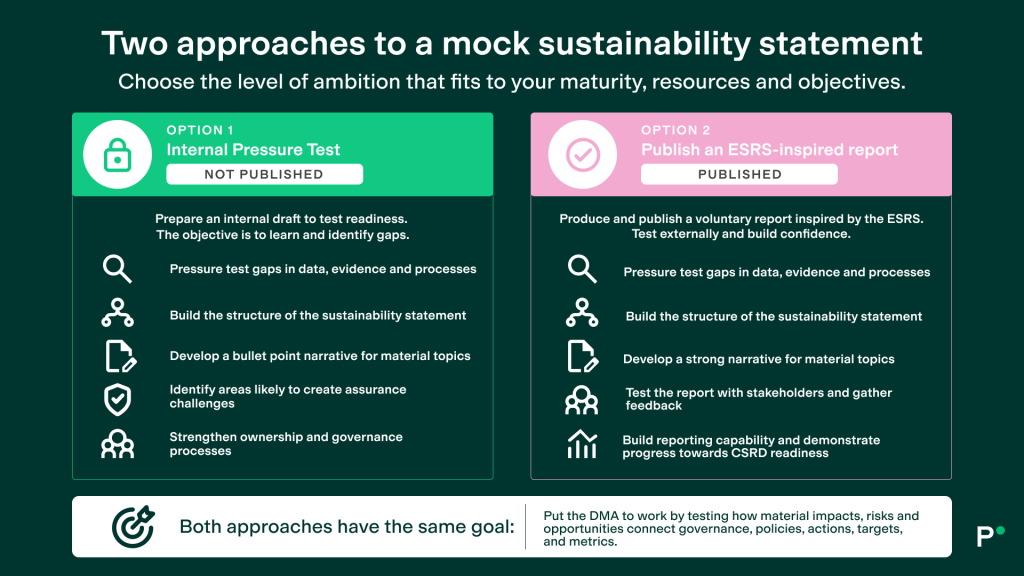
A mock report does not need to be a fully compliant ESRS sustainability statement.
Companies can choose a level of ambition that reflects their maturity, resources and objectives.
Option 1: Internal pressure test
The lower-effort approach is to prepare an internal draft sustainability statement that is never published.
The objective is not to create a polished report. It is to test readiness.
Rather than producing a report with refined narratives and fully developed disclosures, companies can take a pragmatic, bullet-point approach focused on assessing whether the necessary information, evidence and processes are in place.
This approach can help companies:
- identify data and evidence gaps;
- test reporting processes and controls;
- establish the structure of the sustainability statement;
- develop a high-level narrative for material topics; and
- identify areas likely to create assurance challenges.
For many companies, this level of preparation may be sufficient to significantly reduce assurance risks in FY2027.
Option 2: Publish an ESRS-inspired report
A higher-effort approach is to publish a voluntary sustainability report during FY2026 that draws on the structure and principles of the ESRS.
This achieves the same objectives as the internal pressure test while providing additional benefits, particularly with external stakeholders.
Companies can:
- test how the report works for external stakeholders;
- refine the narrative and presentation of disclosures;
- strengthen internal reporting disciplines;
- build familiarity with the reporting process; and
- demonstrate public progress towards CSRD readiness.
Importantly, the report does not need to claim ESRS compliance. The objective is to develop reporting capability and identify improvement opportunities before mandatory reporting begins.
Putting the DMA to work
Regardless of the level of ambition, a mock sustainability statement helps companies put the DMA to work.
After investing significant time and effort into the assessment, organizations can use the mock report to test how material impacts, risks and opportunities flow through the sustainability statement and connect to governance, policies, actions, targets and metrics.
The benefits of a mock report
Benefit 1: Prepare for the qualitative reporting challenge
One of the most consistent lessons from Wave 1 companies is that they underestimated the amount of qualitative information required under ESRS.
Many organizations naturally focus on quantitative disclosures and data collection. They identify datapoints, establish data owners and build reporting processes.
However, the sustainability statement is not primarily a quantitative report.
Many ESRS disclosures require companies to explain how they manage material impacts, risks and opportunities. This includes governance and decision-making processes, policies, actions, targets and methodologies.
During the Position Green webinar, Ida Ljungkvist, Group Sustainability Director at Scandi Standard, highlighted this as one of the biggest lessons from the company’s first reporting cycle.
Like many organizations, Scandi Standard initially focused on data collection. Preparing the sustainability statement, however, also required significant work on policies, governance documentation, methodologies and supporting evidence, areas that often take considerable time to develop and formalize.
Policies are a good example. From drafting and internal stakeholder review to board approval, the process can take several months. These are not tasks that can be completed in the final weeks before publication of the annual report.
More broadly, Scandi Standard’s experience illustrates that preparing an ESRS sustainability statement is not simply a data collection exercise. It requires companies to explain how they govern, manage and respond to their material impacts, risks and opportunities.
Benefit 2: Define the structure of the sustainability statement
A mock report is also an opportunity to make one of the most important reporting decisions before the compliance year begins: how the sustainability statement should be structured.
Many first-year Wave 1 ESRS reports followed the structure of the standards themselves and focused primarily on demonstrating compliance.
Reporting practice has evolved significantly since then.
The objective is not simply to present disclosures. It is to create a sustainability statement that clearly explains how the organization manages its most material impacts, risks and opportunities.
This is often described as creating a “red thread” throughout the report.
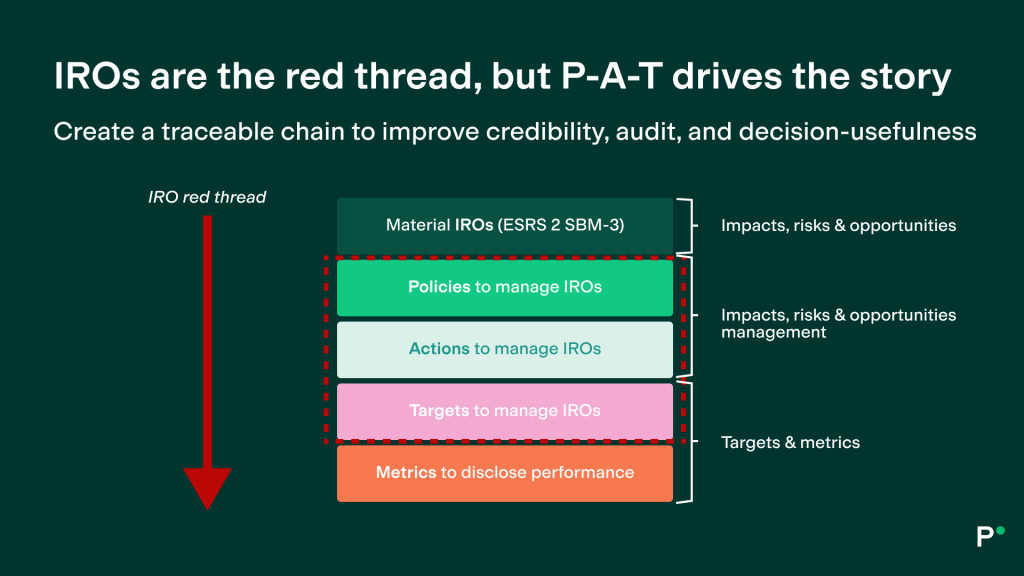
The double materiality assessment identifies the material impacts, risks and opportunities. These then connect to governance, policies, actions, targets and metrics. A strong sustainability statement makes these connections visible and easy for users to follow.
Sustainability reporting teams should also engage early with the financial reporting team to determine how incorporation by reference to the management report will be used for strategy, business model and governance disclosures.
The simplified ESRS also introduces new structural options for FY2026 reporting, including the use of an executive summary.
Putting all this together, a mock report provides an opportunity to design and test a detailed reporting structure, what Position Green calls a “wireframe”, that not only supports compliance but also helps create a clear, coherent and decision-useful sustainability narrative.
Benefit 3: Learn from Wave 1 best practice
The FY2025 sustainability statements from Novo Nordisk and Vestas demonstrate how quickly reporting practice is evolving.
Rather than simply refining first-year compliance reports, both companies focused on improving decision-usefulness, strengthening structure and making sustainability information easier to navigate and understand.
Novo Nordisk structured significant parts of its reporting around prioritized material topics rather than simply following the order of the ESRS standards. Vestas introduced an extensive executive summary and stronger navigation focused on helping readers understand the most important sustainability issues.
A mock sustainability statement provides an opportunity to test these approaches before mandatory reporting begins. Companies can experiment with structure, navigation, executive summaries and topic prioritization and determine what works best for their organization and stakeholders.
Benefit 4: Improve assurance readiness
For many Wave 2 companies, FY2027 will be the first time sustainability information is subject to limited assurance.
A mock sustainability statement allows companies to test whether disclosures, evidence and controls are sufficiently robust to withstand a limited assurance engagement.
It also creates an opportunity to engage auditors early and obtain feedback on structure, evidence requirements and reporting expectations before the first assurance engagement.
Benefit 5: Build the case for investment in FY2027
A mock sustainability statement also helps sustainability teams make the case for additional investment and resources.
Many reporting gaps only become visible when disclosures are drafted and reviewed together.
Data limitations, documentation weaknesses, ownership issues and resource constraints are often easier to demonstrate through a draft sustainability statement than through a project plan or gap assessment.
This gives management a clearer understanding of what still needs to be addressed in FY2027 and helps priorities investment in systems, controls, governance and reporting processes.
Treat FY2026 as a rehearsal year
Wave 2 companies have an opportunity that many Wave 1 companies did not.
They have a preparation year to identify missing data, weak controls, gaps in policies, unclear ownership, weaknesses in reporting narratives and areas where additional investment is needed.
These are precisely the kinds of issues companies want to uncover in FY2026, not during their first limited assurance engagement in late 2027.
A mock sustainability statement turns preparation into proof. It tests whether the organization can actually produce an assurance-ready ESRS sustainability statement, rather than simply plan for one.
That is why FY2026 should be treated as a rehearsal year.
The objective is not to produce a perfect sustainability statement. It is to identify weaknesses while there is still time to fix them.
For Wave 2 companies, a mock sustainability statement may be the single most effective way to prepare for CSRD compliance, simplified ESRS reporting and limited assurance. It allows organizations to identify weaknesses in data, governance, controls, documentation and reporting processes before mandatory reporting begins in FY2027.

Simon Taylor
Senior Director
Position Green