


How Eleiko turned sustainability reporting into a strategic advantage
For Eleiko, the decision was straightforward.

Eleiko chose to continue aligning with the European Sustainability Reporting Standards (ESRS), despite no longer being legally required to do so. The reason was simple: sustainability reporting had already begun delivering value far beyond compliance.
After investing more than a year in a Double Materiality Assessment (DMA), Eleiko had gained a much deeper understanding of where sustainability intersected with business performance. The process helped identify material impacts, risks, and opportunities across the organisation, creating insights that informed both reporting and strategic decision-making.
As Head of Sustainability and Quality, Simone Rishede explains:
“Once you understand where your impacts, risks, and opportunities are, it doesn’t feel right to just stop there.”
What started as a regulatory requirement had evolved into something much more valuable: a structured framework for understanding risk, prioritising actions, and building long-term resilience.
From compliance pressure to strategic clarity
The turning point came through Eleiko’s DMA, which brought together more than a year of work across the organisation.
The assessment provided a clear view of where the business creates impact, where it faces exposure to risk, and where opportunities for improvement exist. Rather than generating information purely for reporting purposes, the process created a foundation for more informed decision-making.
The insights also helped establish stronger links between sustainability data and business priorities. Because reporting was tied directly to material impacts and risks, the information became relevant not only to sustainability teams but also to management and operational decision-makers.
For Joel Östman, Sustainability Coordinator, this is where the value of ESRS reporting becomes clear. The framework creates transparency around both risks and opportunities, helping the company understand where resilience can be strengthened and where action will have the greatest impact.
As a result, sustainability reporting has become less about disclosure and more about business intelligence.
Why Position Green
As Eleiko’s sustainability ambitions grew, so did the complexity of managing data, reporting requirements, and stakeholder expectations.
The company needed more than spreadsheets or general-purpose business intelligence tools. It needed a solution built specifically for ESG management.
While Eleiko could have developed internal processes using spreadsheets or platforms such as Power BI, the company saw greater value in a dedicated ESG platform supported by sustainability specialists.
That combination of technology and expertise proved decisive.
A platform built for ESG complexity
Unlike generic reporting tools, Position Green is designed around ESG workflows, reporting frameworks, and sustainability standards such as the GHG Protocol and ESRS.
This provided Eleiko with a structured approach to managing carbon accounting, double materiality assessments, and sustainability reporting within a single environment. Rather than maintaining separate systems and processes, the company gained a centralised platform capable of supporting both current requirements and future needs.
Expertise alongside technology
For Eleiko, the partnership extended beyond software.
Access to ESG specialists provided support in areas such as Scope 3 screening, emissions calculations, and evolving regulatory requirements. The combination of platform capabilities and expert guidance helped accelerate progress while allowing the company to build its own internal competence.
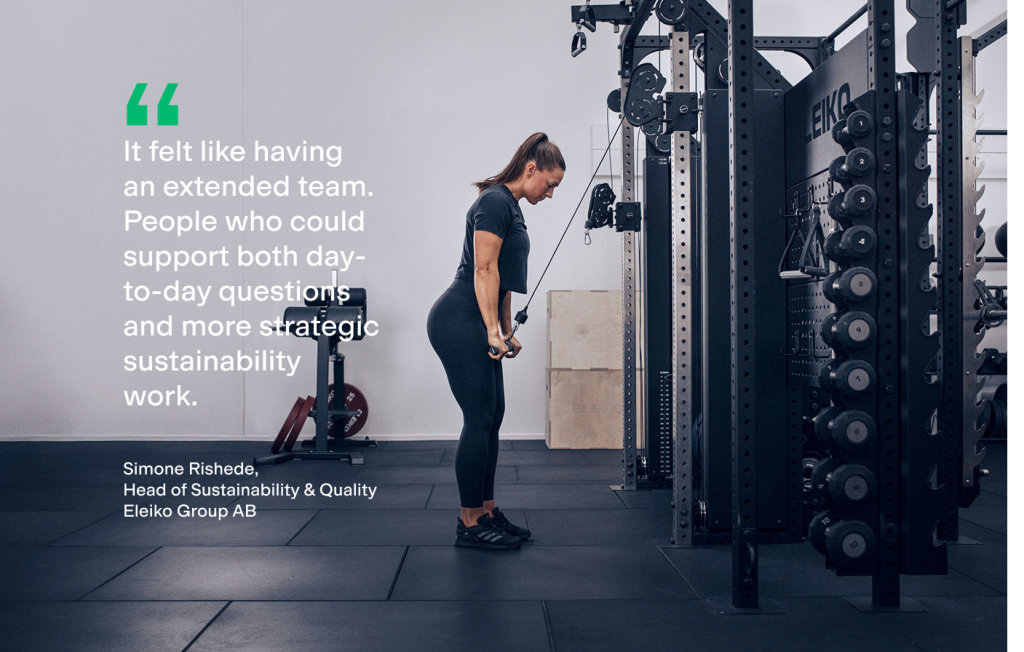
Rishede describes the relationship as an extension of the team:
“It felt like having an extended team. People who could support both day-to-day questions and more strategic sustainability work.”
A platform that evolves with the business
Another advantage has been the platform’s ability to develop alongside Eleiko’s needs.
As reporting requirements evolve and new use cases emerge, feedback from users helps shape ongoing improvements. This has enabled the platform to remain aligned with the realities of sustainability work rather than becoming a static reporting tool.
Ease of adoption
Despite the complexity of ESG reporting, implementation was not hindered by the technology itself.
The larger challenge was understanding sustainability methodologies and standards such as the GHG Protocol. The platform provided an intuitive structure that made it easier for users to engage with complex sustainability data and reporting requirements.
From spreadsheets to a scalable ESG system
Eleiko’s sustainability reporting journey began in 2017 with a small internal team tracking emissions, energy use, waste, and transport data through spreadsheets.
At the time, this approach was sufficient. However, as sustainability reporting matured and stakeholder expectations increased, the limitations became increasingly apparent. Maintaining data quality, transparency, and consistency became more difficult, while manual processes created inefficiencies and increased risk.
The company needed a more structured and scalable approach that could support both current reporting requirements and future ambitions.
Position Green provided that foundation.
Turning ESG data into business intelligence
One of the most significant changes since implementing a dedicated ESG platform has been the way sustainability data is used across the business.
Rather than reporting for reporting’s sake, Eleiko now uses sustainability information to guide decisions and prioritise actions.
Transport emissions offer a clear example. Analysis revealed that while air freight represented less than one percent of shipments, it accounted for more than 30 percent of transportation-related emissions.
Insights like these help translate sustainability data into business decisions by showing where interventions can have the greatest impact.
As Rishede notes:
“That insight changes the conversation completely. It helps colleagues understand where we should focus our efforts.”
The same data-driven approach is now being applied across product development, procurement, and operational decision-making.
Sustainability data is increasingly embedded into the products Eleiko designs and develops. Watch how the company is bringing its sustainability ambitions to life across the product lifecycle:
Ready to turn sustainability into business value
Eleiko’s experience shows that sustainability reporting can deliver far more than compliance. With the right processes, data, and technology in place, it can help organisations understand risk, identify opportunities, improve decision-making, and build long-term resilience.
If you’re looking to move beyond spreadsheets and fragmented ESG processes, and want to understand how sustainability can create measurable business value, explore Position Green and discover how leading companies are turning sustainability data into strategic insight.