

Mind the regulatory gap: The real barriers to effective carbon management
Yet many sustainability teams continue to face the same challenges: fragmented data, resource-intensive reporting cycles, and limited capacity to move beyond compliance.
The question is no longer whether the tools exist. It is why so many organizations still struggle to use them, while staying ahead of the rapidly rising regulatory curve.
The answer often has less to do with software capability and more to do with the organizational realities surrounding carbon data. Emissions information sits across procurement, finance, operations, facilities, travel, logistics, and supplier networks. Reporting requirements continue to expand, while sustainability teams are often expected to coordinate increasingly complex processes without equivalent increases in authority or resources.
As a result, many organizations are discovering that carbon management is no longer primarily a technology challenge. It is increasingly a governance, process, and organizational capability challenge.
Carbon data rarely belongs to the sustainability team
One of the most persistent obstacles in carbon management is that sustainability teams are responsible for reporting emissions without owning most of the underlying data.
Scope 1 data may sit with facilities or fleet managers. Scope 2 data often resides within procurement or finance. Scope 3 data typically spans suppliers, logistics providers, travel systems, purchasing teams, and external partners.
This creates a structural challenge for almost every organization. Before emissions can be calculated, reported, or analyzed, sustainability teams often need to coordinate dozens of stakeholders across the business. Considerable effort goes into collecting, validating, and reconciling information before meaningful analysis can begin.
For many organizations, the challenge is not a lack of data. It is the effort required to gather that data consistently, validate it, and convert it into information that can support decision-making. Data quality issues often stem from fragmented ownership, inconsistent methodologies, and competing priorities across departments rather than from technology limitations alone.
This is one reason why carbon reporting frequently becomes a coordination exercise before it becomes an analytical one. But wait, there’s more…
Reporting requirements have expanded faster than organizational readiness
The reporting landscape has changed significantly over the last several years.
CSRD reporting requirements have entered force. California’s climate disclosure requirements are approaching implementation. ISSB adoption continues to expand globally. At the same time, investor expectations, customer requirements, and supply chain disclosure requests continue to increase.
Most organizations support greater transparency around climate performance. The challenge is that reporting obligations have often expanded faster than the organizational structures required to support them.
Many sustainability functions remain relatively lean compared with the breadth of information they are expected to coordinate. Teams that are still building foundational data processes are simultaneously being asked to improve data quality, strengthen governance, engage suppliers, prepare for assurance, and respond to multiple reporting frameworks.
As requirements mature, organizations are increasingly realizing that carbon management cannot sit solely within the sustainability function. Finance, procurement, operations, IT, and leadership teams all play a role in ensuring data quality, accountability, and reporting readiness.
Without that broader organizational support, even the most capable sustainability teams can struggle to scale their efforts effectively.
The compliance trap
One of the most interesting observations emerging across the market is what many practitioners describe as a compliance trap.
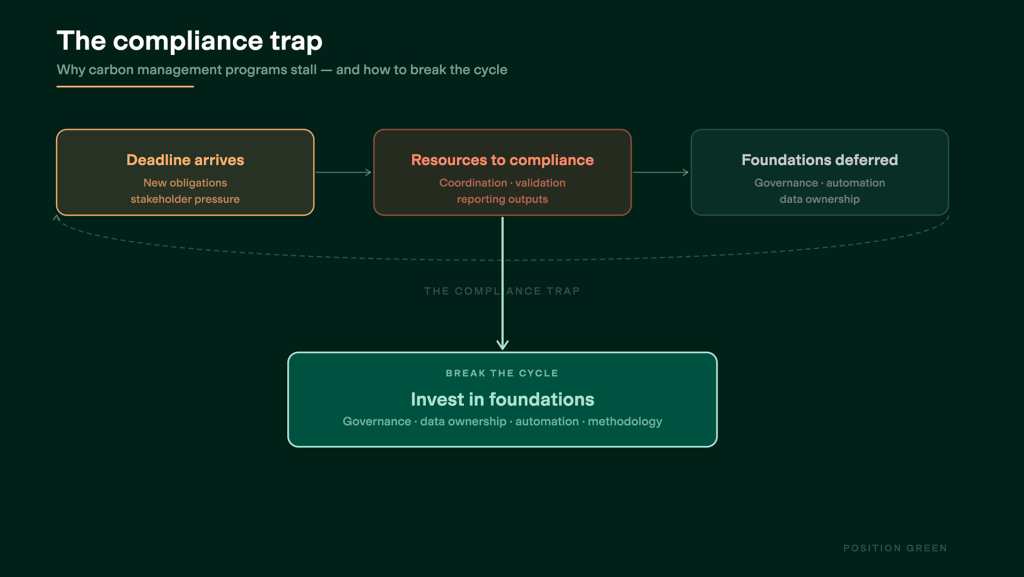
Each reporting cycle introduces new deadlines, disclosure requirements, and stakeholder expectations. Meeting those immediate obligations naturally becomes the priority.
Over time, organizations can find themselves dedicating most of their available resources to producing compliance outputs while postponing the foundational work that would make future reporting cycles more efficient.
This often includes activities such as:
- Establishing stronger data governance
- Automating data collection
- Standardizing methodologies
- Building supplier engagement processes
- Embedding carbon considerations into procurement and investment decisions
- Clarifying ownership and accountability across functions
These activities may not immediately improve the next reporting deadline. However, they often determine whether reporting becomes easier or more difficult in the years ahead.
Organizations that remain permanently focused on the next disclosure cycle can struggle to create the foundations required for long-term efficiency and scalability.
Why technology alone is rarely enough
Technology remains an essential part of effective carbon management.
Modern carbon management platforms can significantly improve data management, reporting consistency, audit readiness, and multi-framework compliance. However, even the most sophisticated software cannot solve governance challenges on its own.
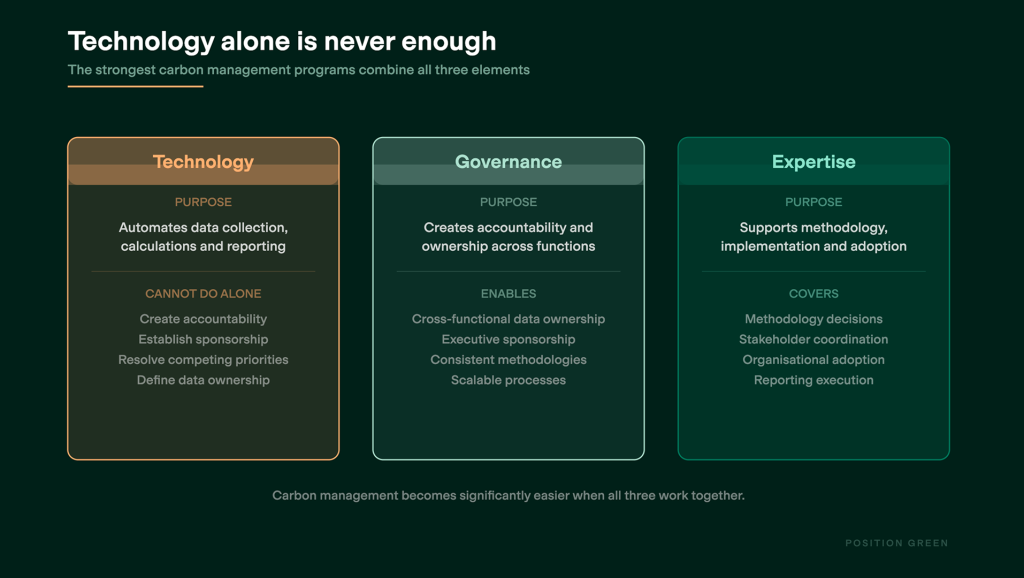
Technology cannot automatically create accountability across functions. It cannot establish executive sponsorship. It cannot resolve conflicting priorities between procurement, finance, operations, and sustainability teams. Nor can it determine how an organization should structure ownership of carbon data across the business.
Those are organizational decisions. This helps explain why some organizations achieve strong outcomes using relatively simple systems, while others continue to struggle despite significant investments in technology.
The differentiator is often not the software itself, but the operating model surrounding it.
Organizations making the most progress are increasingly combining technology with specialist expertise. Software can automate calculations, workflows, and reporting outputs, but governance, stakeholder coordination, and methodology decisions still require human ownership.
As reporting requirements become more complex, many organizations are looking for support models that combine both capabilities rather than treating them as separate decisions.
The strongest carbon management programs typically combine three elements:
| Capability | Purpose |
| Technology | Automates data collection, calculations, and reporting workflows |
| Governance | Creates accountability and ownership across functions |
| Expertise | Supports methodology, implementation, and organizational adoption |
Carbon management becomes significantly easier when all three are working together.
Carbon management is becoming a business process
One of the most important shifts occurring across the market is that carbon data is increasingly moving beyond sustainability reporting.
Leading organizations are beginning to integrate emissions information into:
- Procurement decisions
- Supplier engagement
- Capital expenditure planning
- Product development
- Risk management
- Commercial decision-making
This changes how carbon data is valued internally.
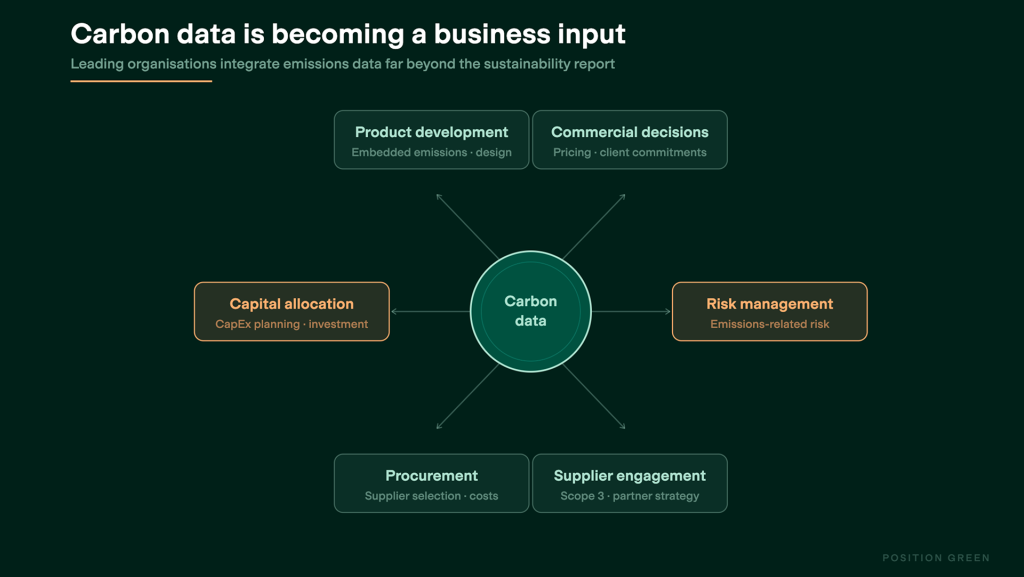
A supplier emissions dataset may help satisfy reporting requirements, but it can also support procurement strategies, supplier risk assessments, and decarbonization initiatives. Energy consumption data can support emissions reporting while simultaneously identifying efficiency opportunities and cost savings.
When carbon data serves multiple business objectives, organizations often find it easier to secure internal engagement and investment.
This is one reason carbon management is increasingly becoming a cross-functional capability rather than a standalone sustainability process.
Building capability, not just compliance
As reporting requirements continue to mature, organizations are increasingly recognizing that long-term success depends on more than meeting disclosure obligations.
The companies making the most progress are treating carbon management as a capability-building exercise rather than a reporting exercise alone. That means investing not only in technology, but also in:
- Clear governance structures
- Defined data ownership
- Cross-functional collaboration
- Repeatable methodologies
- Internal knowledge development
- Supplier engagement processes
These capabilities create benefits that extend well beyond a single reporting cycle.
They improve data quality, reduce future reporting effort, strengthen audit readiness, and provide better visibility into emissions-related risks and opportunities.
Organizations that invest in these foundations are often better positioned to adapt as reporting requirements evolve because they have built the underlying processes needed to support future demands.
What should organizations expect from modern carbon management software?
If carbon management is increasingly an organizational challenge rather than a calculation challenge, the role of software is changing as well.
Historically, many carbon management platforms focused primarily on emissions calculations and reporting outputs. Those capabilities remain important, but organizations are increasingly looking for solutions that help address the operational realities sitting upstream of reporting.
The most effective platforms should help organizations manage the processes behind carbon management, not just the final disclosures.
That often includes:
Accelerating data collection and baseline creation
Many carbon management programs stall before they begin because organizations assume they need perfect data ownership and mature governance structures before they can calculate emissions.
In reality, most companies need a trusted starting point first.
Modern carbon management software should help organizations establish an initial emissions baseline quickly by making use of the data that already exists across the business. Rather than relying entirely on manual collection processes, technology should help identify, structure, and process available information efficiently so sustainability teams can begin understanding their emissions profile sooner.
That does not eliminate the need for governance or data ownership. Those remain critical for improving accuracy over time. However, creating a credible baseline early allows organizations to identify hotspots, prioritize improvements, and engage stakeholders using real insights rather than assumptions.
The faster organizations can move from data gathering to decision-making, the more value carbon management can create.
Supporting data ownership
One of the biggest challenges in carbon management is that sustainability teams rarely own the underlying data.
Modern platforms should make it easier to assign ownership, define responsibilities, and engage stakeholders across procurement, finance, operations, and supplier networks.
Reducing coordination burden
Many sustainability teams spend significant time chasing data, sending reminders, validating submissions, and managing reporting cycles.
Technology should reduce that administrative workload wherever possible, allowing sustainability teams to focus on analysis, engagement, and improvement rather than coordination alone.
As reporting requirements expand, organizations increasingly need systems that help manage both data collection and cross-functional collaboration without creating additional process complexity.
Improving transparency and auditability
As assurance requirements increase, organizations need confidence in how data was collected, transformed, and reported. Strong audit trails, version control, documentation, and workflow visibility are becoming increasingly important.
Supporting supplier engagement
For many organizations, Scope 3 emissions represent the largest source of reporting complexity.
Software should help companies engage suppliers more efficiently, collect data consistently, and identify areas where supplier collaboration can improve reporting quality.
Connecting carbon data to decision-making
The most mature organizations are using carbon data beyond reporting.
That means integrating emissions information into procurement, capital allocation, supplier management, and operational planning processes. Technology should support those conversations rather than functioning solely as a reporting tool.
Carbon management is becoming an organizational capability
A few years ago, the primary challenge for many organizations was understanding how to calculate emissions and comply with emerging reporting requirements.
Today, most organizations understand what needs to be reported.
The challenge has shifted toward building the organizational infrastructure required to do it efficiently, consistently, and at scale.
That includes:
- Defining data ownership
- Establishing governance structures
- Creating repeatable reporting processes
- Engaging suppliers
- Aligning sustainability with procurement, finance, and operations
Technology remains an important enabler. But increasingly, the organizations making the most progress are those that treat carbon management as an organizational capability rather than a reporting obligation.
The future of carbon management will likely be shaped less by reporting outputs and more by the systems, governance structures, and organizational practices that sit behind them.
Working on these challenges?
If any of these challenges sound familiar, you’re not alone.
Across industries, sustainability teams are balancing expanding reporting requirements with limited capacity, fragmented data ownership, and growing expectations from regulators, customers, and investors.
Position Green is addressing these challenges through two complementary offerings: specialist carbon management services that help organizations navigate today’s reporting and operational demands, and a next-generation carbon management platform designed around the realities sustainability teams face every day.
Need support now?
Carbon management services
Many organizations understand what effective carbon management looks like. The challenge is finding the capacity, governance structures, and operational support required to get there.
Our specialist carbon management team works alongside sustainability, finance, procurement, and operational functions to support:
- Carbon accounting and reporting
- Data collection and validation
- Methodology alignment
- Supplier emissions engagement
- Audit and assurance preparation
- Ongoing reporting execution
By taking on much of the coordination and reporting burden, organizations can spend more time improving performance and less time chasing data.
Chat to our services teamLooking ahead?
Join the next-generation carbon management waitlist
We’re building a new carbon management platform designed around the challenges highlighted throughout this article.
The goal is not simply to produce reporting outputs. It is to help organizations reduce coordination burden, improve governance, strengthen data ownership, and build more scalable carbon management processes over time.
If you’d like early access to product updates, previews, and launch information:
Register interest