


From compliance to capability: How Greencarrier and Cegal are enabling sustainability beyond their own walls
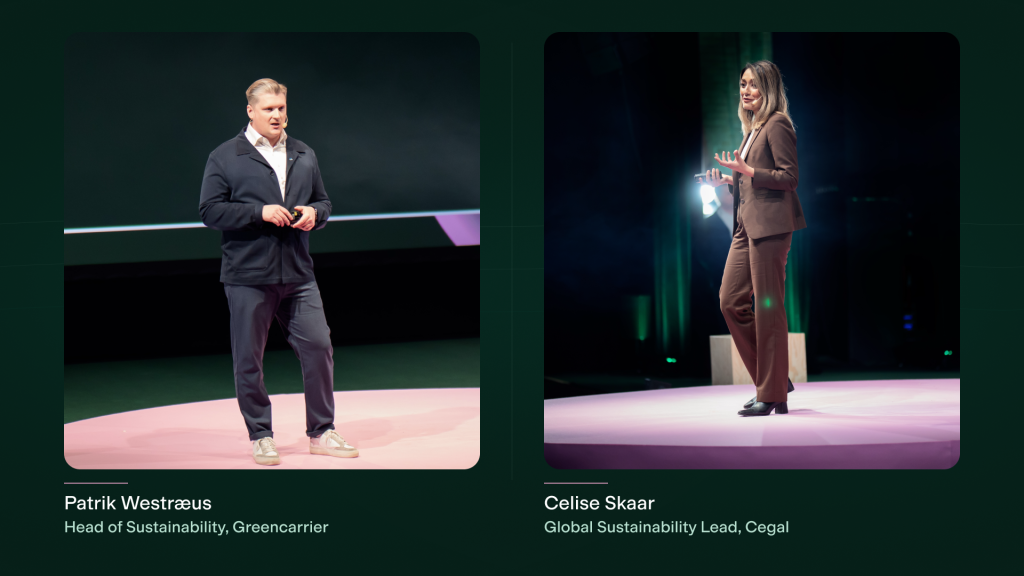
For most companies under ESG pressure, sustainability is still a destination, something to be achieved, reported, and signed off. But a different question is starting to emerge among the organizations doing this work seriously: what if sustainability is not an endpoint at all, but a capability?
Not something you comply with, but something you embed, in your decision-making, in your service offering, in how your teams think. Two companies working with Position Green are testing exactly that idea, and the contrast between their approaches reveals something important about what enabling sustainability actually requires.
The problem with reporting as the product
Celise Skaar leads sustainability at Cegal, a technology company delivering software, consulting, and cloud solutions to the energy sector. Her team is small by design, sustainability at Cegal is a lean, enabling function, not a large central department.
But she identified a structural problem early on that is far from unique to Cegal: the ESG function had become backwards-looking. “The metrics became the work,” she explains. “The report became the product.” A function that was supposed to help the company see and navigate the future had become very good at documenting the past. The data was being produced. The change was not.
This is one of the most common failure modes in corporate sustainability programs, and CSRD is at risk of making it worse. When the regulatory requirement is disclosure, the incentive is to build a machine that discloses well.
The question of whether that machine is actually changing anything, improving decisions, shifting capital, reducing harm, can get lost entirely. Skaar’s response was to reframe what her function was actually for. Not compliance. Not reporting. Something harder and less legible: teaching people how to think.
Embedding System 2 thinking across the organization
Skaar draws on Daniel Kahneman’s framework of System 1 and System 2 thinking to explain the real challenge. Most business decisions are made in System 1, fast, instinctive, based on established patterns.
Sustainability issues, almost by definition, live in System 2: they are structural, delayed in consequence, and require deliberate reasoning to recognize. The insight Skaar landed on is that the actual work is not to get people to care about sustainability, and not even to use the word. “It’s to teach them how to think it,” she says.
If sustainability reasoning can be embedded into how teams approach decisions, without needing to be labelled or flagged each time, it becomes durable in a way that a central reporting function never can be.
Cegal uses a three-ring framework, Control, Influence, and Context, to focus teams on what they can act on rather than what sits beyond their reach. It is a deliberately practical device, designed to make abstract sustainability considerations tractable at a team level. The clearest sign that the approach is working is not found in reporting cycles or governance audits.
It is found in moments like this: highly technical teams deep in build mode, not really natural allies of structured corporate governance, surfaces the question themselves. “We need AI governance; this technology is way bigger than anything.” That is System 2 thinking taking root without being pushed. And it is the only kind of cultural change that holds and is sustainable over time, because it comes from the very function itself.
When Scope 3 becomes a competitive advantage
Greencarrier operates in a different direction. The Sweden-based logistics group, a liner agent for Evergreen, plus consolidation and freight forwarding, faces a sector-level challenge that is almost the inverse of Cegal’s. Shipping is responsible for between two and three per cent of global greenhouse gas emissions, but regulatory pressure in the industry falls primarily on large shipping lines, not on the mid-market agents who sit between them and the customers. In a market competing largely on freight rates, there was no external mandate forcing Greencarrier to act on emissions. They acted anyway, and the reason is instructive.
As an asset-light operator, Greencarrier’s scope 1 and 2 emissions are minimal. When they completed their double materiality assessment, they found that over 99 per cent of their footprint sat in scope 3, in the emissions generated by the logistics services they procure on behalf of customers. That data created the internal mandate that regulation had not. Rather than treating scope 3 as a liability to manage, Greencarrier developed a program of emission reduction services, maritime biofuel insets, sustainable aviation fuel certificates, HVO100, and fuel switch routes, that customers can purchase. The implication is significant: Greencarrier can now help its customers hit their own scope 3 reduction targets. A supplier has become a solution.
Sustainability as a sales lever, and what that means
The commercial logic has been validated in the market. At a customer meeting in Hamburg, a purchasing manager was visibly moved when handed an emission reduction certificate, and told Greencarrier directly that the service “really sets you apart from our other suppliers.”
In Finland, a colleague explained Greencarrier’s program to a customer who responded that they were not going to pay for all of these services. The instinct is to read that as skepticism. It is the opposite. The customer understands that buying from Greencarrier helps them hit their own scope 3 targets, the sustainability value is baked into the relationship, not an add-on.
Patrik Westræus, Head of Sustainability at Greencarrier, draws the lesson plainly: “Meet your customers to prove to them, and to yourselves, that sustainability works.” This matters beyond Greencarrier’s own story. One of the most persistent objections to ambitious sustainability program in mid-market businesses is that customers will not pay for them. Greencarrier’s experience suggests the framing is wrong.
Customers are not being asked to pay for Greencarrier’s sustainability. They are being offered a more sustainable pathway to their own. That is a fundamentally different commercial proposition, and it holds even in a price-sensitive market.
The harder work Is cultural, not technical
Both Cegal and Greencarrier illustrate something that tends to get obscured in the current regulatory cycle: the most durable sustainability program are not primarily technical achievements. Cegal’s competencies in geoscience, developed in oil and gas, have translated into offshore wind, carbon storage, and geological data for renewable energy placement.
The knowledge did not change; the application did. That transition was possible because the organization had built the habit of thinking structurally about where its capabilities could go, not just where they had been. The same logic applies to how Cegal approaches its own sustainability function: the goal is not to build a reporting engine, but to make the organization more capable of reasoning about long-term risk and value.
Skaar is candid about the limits of visibility in this kind of work. “There are probably people at Cegal who will read this article and think, wait, really? And that’s okay,” she says. “This kind of work is hard precisely because it isn’t technical at its core. It’s cultural.” For sustainability managers and CSOs facing pressure to show short-term results, that is a difficult thing to defend. But the evidence from both companies points in the same direction: cultural embedding is slower, less legible, and far more durable than compliance-driven disclosure. When AI teams start asking for governance frameworks because they have reasoned their way to needing them — that is a return on investment that no reporting cycle can capture, but that every organisation should be working towards.
Become your own sustainability enabler through and beyond your business
Position Green works with companies like Greencarrier and Cegal to move sustainability from a reporting obligation to an operational capability, connecting data, strategy, and decision-making in one integrated platform. Whether your priority is scope 3 visibility, cross-functional ESG ownership, or turning compliance into competitive advantage, our team can help you build the foundation that makes it possible.
How we can help