


Resilience becomes strategy: what Position Act 2026 revealed about sustainability leadership
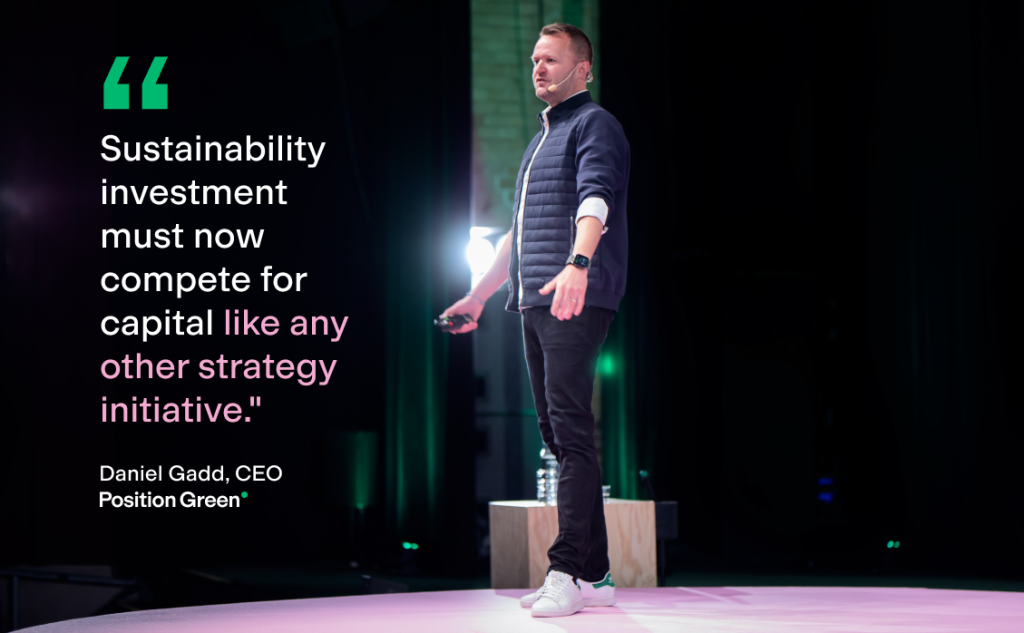
Throughout the day, speakers approached that challenge from different perspectives. Daniel Gadd, CEO of Position Green, framed the increasingly unstable operating environment businesses now face. Johan Rockström, Professor in Earth Systems Science at the University of Potsdam explained why systemic instability itself is accelerating. Andreas Rasche, Professor of Business in Society at Copenhagen Business School connected those pressures to governance, financing, and execution challenges. Later sessions with Wallenberg Investments, Ferd, Greencarrier, and Cegal showed how those shifts are beginning to affect ownership models, customer expectations, and operational decision-making in practice.
Taken together, the sessions reflected a broader shift already happening across many organizations: sustainability is increasingly being treated less as a standalone reporting discipline and more as part of how businesses manage resilience, continuity, and competitiveness.
Daniel Gadd: Sustainability enters an era of operational volatility
Daniel Gadd, CEO at Position Green, opened the day by describing the current business environment and how it is shaped by overlapping disruption.
Trade tensions, geopolitical fragmentation, energy instability, regulatory uncertainty, and rapid advances in AI are all creating new layers of operational complexity for companies already navigating sustainability transformation.
Rather than focusing narrowly on reporting obligations, Gadd described how sustainability discussions are becoming more operational. Companies are increasingly asking questions tied to resilience, dependency, and exposure.
“Reporting and compliance, that is still very important. But new questions are emerging, such as how dependent are we on carbon? Or how resilient is our supply chain? Or where are our risks and opportunities?”
Historically, sustainability reporting often operated as a relatively separate process concentrated around annual disclosures and compliance cycles. But as operating conditions become more volatile, sustainability data is increasingly being used to support procurement decisions, supplier assessments, financing discussions, operational planning, and risk management.
Gadd also emphasized that structured data is becoming increasingly important as organizations integrate AI into business processes, but stressed to not put the AI cart before the data horse.
“AI is only as useful as the data behind it,” he said. “So if you don’t have structured data, you cannot leverage AI.” In other words, unless you are able to organize, validate, and assess your own data within the right context
With the stage set, it was time to understand the why behind resilience is so top of mind for businesses, investors, and stakeholders in 2026, which is where one of the world’s leading climate scientists stepped in.
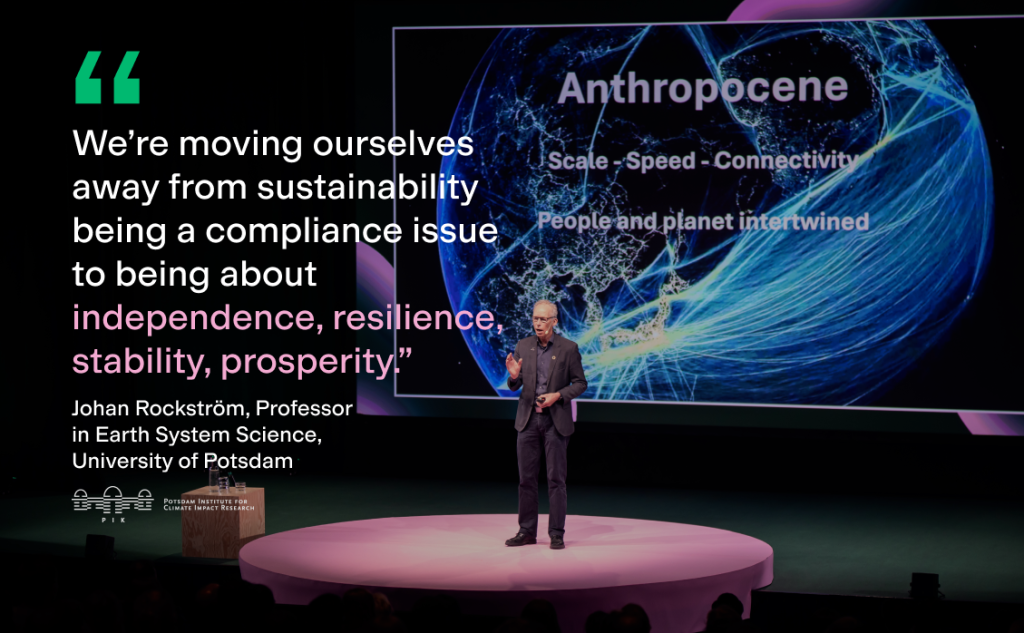
Johan Rockström: Why resilience is becoming a business issue
Johan Rockström’s keynote expanded the conversation from operational volatility to the larger systems driving it.
Rockström painted a poignant picture of the state of the planetary systems we rely on today. Throughout the session, he repeatedly connected planetary instability to operational consequences. Agricultural disruption affects sourcing reliability. Extreme weather affects logistics systems and infrastructure durability. Energy instability affects industrial competitiveness.
When these systems are disrupted, let alone destabilized as a whole, it cascades down supply chains, raising prices, making returns harder to project, and pulling the rug from underneath your business’s roadmap. What’s more, no business operates in local isolation. Resilience is determined globally, even for national players.
“If you care about your supply chains, if you care about your local weather conditions here in Malmö, you must unfortunately today be concerned about the Amazon rainforest, the Greenland ice sheet, the permafrost,” Rockström said.
Importantly, Rockström did not frame sustainability primarily as environmental positioning or compliance. Instead, he argued that resilience itself is becoming strategically important for economic and geopolitical reasons.
That framing created a natural bridge into the following sessions, which focused increasingly on how financial systems, governance structures, and corporate decision-making are beginning to respond.
Andreas Rasche: Financial systems are beginning to price resilience differently
If Rockström explained why instability is increasing, Andreas Rasche focused on how businesses and financial systems are beginning to respond to it.
During his “State of the Union” session, Rasche described how sustainability-related risks are becoming increasingly difficult to separate from operational and financial performance.
Banks, investors, insurers, and boards are placing greater scrutiny on transition readiness, governance quality, operational exposure, and supply chain resilience. Importantly, this is no longer being driven solely by regulation.
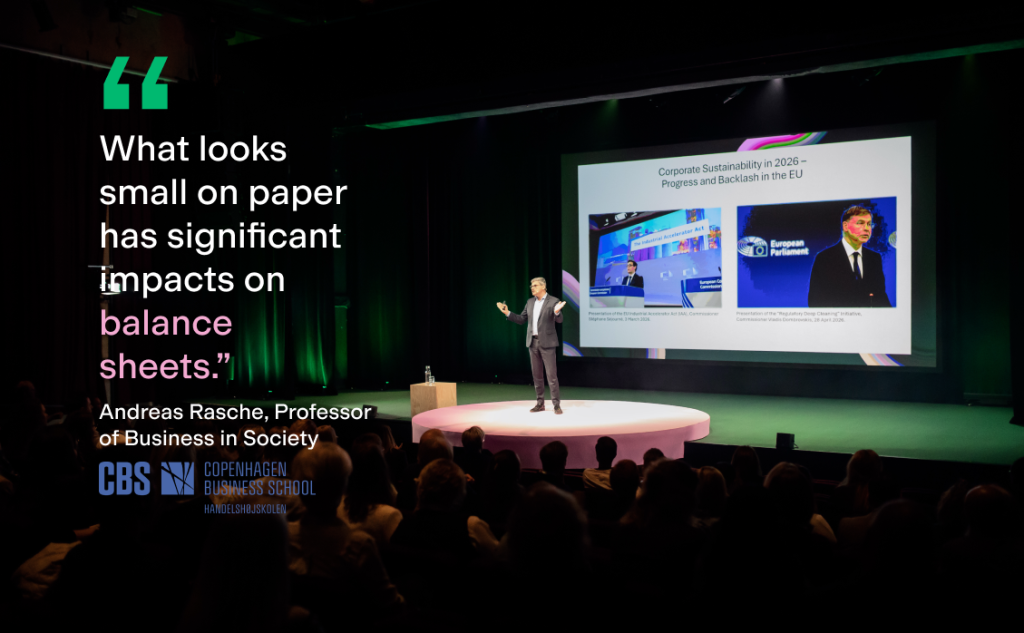
Several parts of the session focused on how financial markets are increasingly evaluating operational fragility itself. Organizations with heavy carbon exposure, concentrated supply chains, weak governance structures, or poor operational visibility are facing growing pressure around financing conditions and long-term competitiveness.
Rather than operating solely as compliance initiatives or reputational programs, sustainability efforts are increasingly tied to operational resilience, procurement continuity, and long-term cost management.
Rasche also addressed one of the recurring themes throughout the day: many organizations no longer struggle to identify sustainability opportunities. The challenge is executing them consistently.
“Companies can often not activate these business cases,” he said. “And this is where the challenge is.”
That execution challenge surfaced repeatedly throughout the afternoon discussions. Organizations often understand where opportunities exist, whether in supplier engagement, operational efficiency, or energy transition. But implementing those changes consistently across finance, procurement, operations, and leadership teams remains difficult. As a result, governance quality increasingly becomes a differentiator.
Wallenberg Investments and Ferd: Long-term ownership changes resilience decisions
The live recording of the Sustainable Edge podcast shifted the discussion from operational systems and financial pressure toward leadership, ownership, and long-term stewardship.
Featuring two voices from the largest investment families in Scandinavia, Siri Sachs from Wallenberg AB and Johan H. Andersen of Fern, the conversation explored how large industrial owners think about resilience across generations rather than reporting cycles.
Rather than discussing sustainability as a separate initiative, the panel framed resilience through leadership responsibility, continuity, and long-term value creation.
That perspective added an important dimension to the day’s broader discussion. Many sustainability investments require organizations to think beyond quarterly cycles, particularly when addressing supply chain resilience, energy systems, infrastructure adaptation, or operational transformation.
Companies with stronger long-term governance structures are often better positioned to absorb transition costs, maintain strategic consistency, and continue investing through periods of uncertainty.
In that sense, the session reinforced a broader pattern visible throughout Position Act 2026: resilience increasingly depends as much on governance quality and leadership alignment as it does on technical sustainability expertise.
Greencarrier and Cegal: Operational resilience becomes commercial strategy
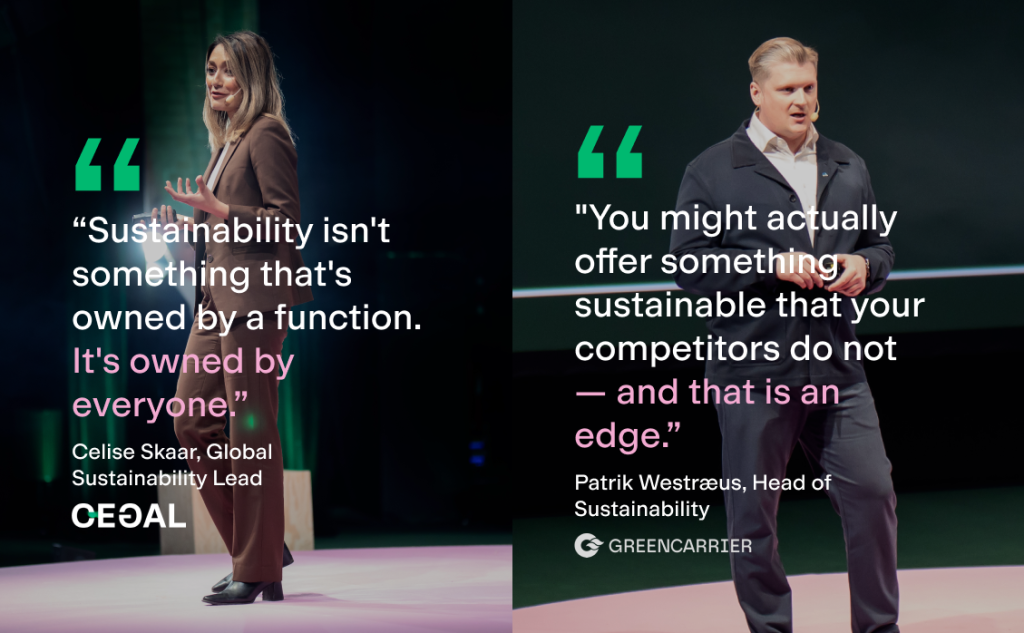
The afternoon customer sessions brought the earlier discussions into practical implementation. This was spelled out by Patrik Westræus, Head of Sustainability at Greencarrier and Celise Skaar, Global Sustainability Lead at Cegal.
Both Greencarrier and Cegal focused less on sustainability reporting itself and more on how sustainability initiatives increasingly affect competitiveness, customer expectations, and operational performance.
For Greencarrier, operating within logistics and freight forwarding means navigating a market already exposed to geopolitical instability, transport disruption, fuel volatility, and changing customer expectations.
Rather than treating sustainability as a parallel reporting exercise, the discussion centered on how sustainability initiatives increasingly shape commercial positioning and customer relationships.
“We started asking: is there something else we can do?” Patrick explained. “Being a hybrid group of businesses and seeing that customers need to sustain their own business, maybe this is something we can explore together.” In other words, can we make sustainability such a fundamental part of how the business operates that the line between strategy and sustainability becomes indistinguishable.
This was further compounded by Cegal’s approach. With a single sustainability professional working across departments from finance to operations, Celise built ways of working that enabled sustainability in line with how the teams already viewed their critical tasks.
By changing how organizations operationalize sustainability across multiple regions and business units, they were able to scale
Both sessions reinforced a broader point that surfaced repeatedly throughout the day: sustainability initiatives gain significantly more traction when they become integrated into procurement decisions, operational workflows, commercial offerings, and customer expectations.
What this means for businesses moving forward
One of the clearest takeaways from Position Act 2026 was that sustainability leadership is becoming significantly more strategic in practice.
The discussions throughout the day consistently moved away from sustainability as a standalone reporting exercise and toward sustainability as part of how organizations manage resilience, procurement exposure, operational continuity, financing conditions, and competitiveness.
First, organizations are increasingly being evaluated on the quality of their operational visibility. As supply chains become more volatile and financial institutions place greater scrutiny on governance quality and transition readiness, fragmented reporting structures and disconnected data systems become harder to sustain.
Second, governance quality is becoming increasingly important. Several sessions highlighted that organizations rarely struggle to identify sustainability opportunities. The larger challenge is operationalizing them consistently across procurement, finance, operations, and leadership teams.
Third, sustainability is becoming more commercially connected. The customer discussions showed how sustainability expectations increasingly influence procurement requirements, customer relationships, and market access.
Finally, the event reflected a broader shift in how resilience itself is understood. Resilience is no longer being framed solely as risk reduction or regulatory preparedness. Increasingly, it is being treated as an operational capability: the ability to adapt under pressure, maintain continuity during disruption, and make informed decisions in more volatile conditions.
It requires operational systems, governance structures, and leadership teams capable of integrating sustainability into how the business actually runs.